Showing posts with label media. Show all posts

3/29/2017

Bible Verses in Song: “I Am Not the Same”

I struggle to know who I am. What is my identity? What makes me me? I have a really hard time untangling my identity from the things I’ve done and the things I do. Things of which I’m ashamed. At my core, I know I am a sinner. What I fail to realize so often is that I am also a redeemed and pardoned child of God, hurting and in constant need of grace.

“I Am Not the Same” is a song written by Aaron Keyes, Ben Smith, Pat Barrett, and Matt Redman. Here’s a link to a video of this song as performed by Seventh Day Slumber: https://www.youtube.com/watch?v=vCJ3eHYs3vI. Below are several verses from the Bible that affirm the words in this song. My prayer is that I can internalize these truths and live in the freedom Christ purchased for me, to remember I am not the same as my past or my sin. I am a new creation in Christ.

Verse 1:

Thus says the Lord Yahweh: In the day that I cleanse you from all your iniquities, I will cause the cities to be inhabited, and the waste places shall be built…. [A]nd the waste and desolate and ruined cities are fortified and inhabited. Then the nations that are left around you shall know that I, Yahweh, have built the ruined places…. (Ezek 36:33, 35–36)
… God is love, and he who remains in love remains in God, and God remains in him. In this love has been made perfect among us, that we may have boldness in the day of judgment, because as he is, even so are we in this world. There is no fear in love; but perfect love casts out fear…. (1 John 4:16–18)

Verse 2:

We were buried therefore with him through baptism to death, that just as Christ was raised from the dead through the glory of the Father, so we also might walk in newness of life. (Rom 6:4)
Blessed be the God and Father of our Lord Jesus Christ, who has blessed us with every spiritual blessing in the heavenly places in Christ; even as he chose us in him before the foundation of the world, that we would be holy and without defect before him in love…. (Eph 1:3–4)

Pre-Chorus:

[God] predestined us for adoption as children through Jesus Christ to himself…. (Eph 1:5)
[Christ him]self bore our sins in his body on the tree, that we, having died to sins, might live to righteousness; by whose stripes you were healed. (1 Pet 2:24)
[Yahweh] raises up the poor out of the dust.
He lifts up the needy from the dunghill,
To make them sit with princes,
and inherit the throne of glory.
(1 Sam 2:8)
You were dead through your trespasses and the uncircumcision of your flesh. He made you alive together with him, having forgiven us all our trespasses…. (Col 2:13)
Which of you men, if you had one hundred sheep, and lost one of them, wouldn’t leave the ninety-nine in the wilderness, and go after the one that was lost, until he found it? When he has found it, he carries it on his shoulders, rejoicing. (Luke 15:4–5)
He rescued me from my strong enemy and from those who hated me, for they were too mighty for me…. He brought me out into a broad place; he rescued me, because he delighted in me. (Psalm 18:17, 19; ESV)

Chorus:

Therefore if anyone is in Christ, he is a new creation. The old things have passed away. Behold, all things have become new. (2 Cor 5:17)
Don’t be afraid; for you will not be ashamed.
Don’t be confounded; for you will not be disappointed.
For you will forget the shame of your youth;
and the reproach of your widowhood you shall remember no more.
(Isa 54:4)

Bridge:

After this, Jesus, seeing that all things were now finished, that the Scripture might be fulfilled, said, “I am thirsty.” … When Jesus therefore had received the vinegar, he said, “It is finished.” He bowed his head, and gave up his spirit. (John 19:28, 30)
For he has looked down from the height of his sanctuary.
From heaven, Yahweh saw the earth;
to hear the groans of the prisoner;
to free those who are condemned to death.
(Ps 102:19–20)
The God of our fathers raised up Jesus, whom you killed, hanging him on a tree. God exalted him with his right hand to be a Prince and a Savior, to give repentence to Israel, remission of sins. (Acts 5:30–31)
The seventh angel sounded, and great voices in heaven followed, saying, “The kingdom of the world has become the Kingdom of our Lord, and of his Christ. He will reign forever and ever!” (Rev 11:15)

Scripture quotations marked (ESV) are from the ESV® Bible (The Holy Bible, English Standard Version®), copyright © 2001 by Crossway, a publishing ministry of Good News Publishers. Used by permission. All rights reserved. May not copy or download more than 500 consecutive verses of the ESV Bible or more than one half of any book of the ESV Bible.

In the acknowledgment above, fair use constitutes permission. See https://www.crossway.org/permissions/ for information on copyright and permissions.

All other Scriptures:
Scripture quoted from the World English Bible. The World English Bible is in the Public Domain. That means that it is not copyrighted. See copyright information here: https://worldenglishbible.org/.

11/16/2015

No Longer Invisible

The other day as I browsed my Netflix watch list for a way to occupy some of my Friday evening, I noticed a documentary was about to be removed. It's a documentary I've seen before, and even four-starred (out of five possible stars). And believe you me, I am stingy with those stars. The documentary is called The Invisible War. In it, filmmakers Kirby Dick and Amy Ziering interview dozens of women and men discussing the topic of military sexual trauma.

When I hear the words “military” and “trauma” in the same phrase, I think of PTSD resulting from combat, the horrific experiences felt and witnessed by men and women in war. Toss the word “sexual” in the middle of those two oft-linked words and the issue gets confused. String those three words together and my mind goes to POWs grossly abused and tortured as in the events that took place at Abu Ghraib. Certainly that would qualify as military sexual trauma. But this documentary is about US soldiers who have been traumatized and assaulted, not about US soldiers perpetrating heinous crimes against foreign POWs. The military sexual trauma discussed throughout The Invisible War, indeed the “invisible war” itself, is the infliction of sexual crimes by US military against US military and the ensuing battles that rage within and around the survivors as they try to come to terms with this most personal betrayal and seek justice from a biased and unjust system that would rather close its eyes and ears.

My understanding is that since the release of The Invisible War, several members of Congress have taken a keen interest in the plight of US military women and men who have been hurt and betrayed by their very own. A recent bill, the Military Justice Improvement Act of 2013, attempted to address flaws in the military justice system, but did not gain enough support to become law. Though the bill was not enacted there have been changes in how the military handles sexual assault cases. The documentary gives a bit of insight into those changes.

At the end of The Invisible War, the viewer is directed to the website http://www.notinvisible.org/. Shortly after viewing this documentary for the first time, I added that link to the “Helpful and Informative Sites” section of my blog (see “Not Invisible — US military” under the “PTSD” section heading). The website contains a variety of resources, current events, and general information for vets who experienced sexual assault while serving in the military. To the affected service men and women, the war you have fought and are fighting against military injustice and sexual trauma no longer has to be kept secret; this no longer must be an invisible war.

As I reflect on my own (nonmilitary) experiences with sexual trauma, I realize that one of the hardest parts was carrying the secret of what happened on my own. For more than two years, I lived completely alone with it, with the fear, the guilt, the shame, the sadness. I still struggle with that today. With keeping certain aspects of my experiences secret. Sometimes just the thought of someone else knowing even a little bit of what happened is enough to terrify me. But then, when that surge of fear passes, I know it is good to not keep this a secret. I need to not be invisible. If the war is invisible—if my struggles are invisible—I cannot be helped. And that may be as tragic as the experiences themselves.

Whether your heart seeks out stories of injustice because you are overflowing with desire to show compassion to the wounded in your community or whether you know someone personally who is struggling with issues or life events like those discussed in the film, I recommend you watch The Invisible War and find out how you can get involved. You can stream it on Netflix until 11/20/15. It is also available on iTunes or Amazon. And I'm sure there are a variety of other ways you can gain access to it as well. However, be warned that if you are easily triggered by this topic, you should proceed with caution. This film contains several accounts of sexual assault, some discussion on suicide, and some instances of harsh language.

6/22/2015

Reflecting on Inside Out

Yesterday afternoon I went to see Disney•Pixar's newest feature, Inside Out. I've been anticipating this movie's release for the past several weeks, and I was not disappointed. It's an ambitious undertaking to personify human emotions in a movie palatable and entertaining for children and adults alike. But Disney•Pixar didn't stop there. They incorporated several other mental processes into the storyline as well: Abstract thought, Dreaming, and Long-term memory, just to name a few.

Accurately and thoroughly depicting all of these processes and concepts isn't the main purpose of the film. So I'm sure there are neuropsychologists and -scientists out there who can poke holes in some of the finer points of the plot. But, in my opinion, the filmmakers did an incredible job of creating visual representations of these processes in a complex story about a complex subject: the human mind. And WOW, is it visually stunning! Ever wonder what a train of thought looks like? Ever picture different aspects of your personality? Ever imagine how big a storage facility would need to be to contain all of your memories? The human mind is an impressive structure and the Disney•Pixar team illustrates this in clever and interesting ways.

In addition to the intriguing story and impressive visuals, the cast of actors who voiced the emotion characters was well selected. Who embodies Joy better than Amy Poehler, who formerly played perennial optimist Leslie Knope in the TV show Parks and Recreation? Who better to voice Disgust than Mindy Kaling (Kelly Kapoor, the workplace snob) and who better to voice Sadness than Phyllis Smith (Phyllis Lapin/Vance, the workplace sulk) from The Office (U.S. version)? While not as familiar with the male members of the emotion crew, I think they were equally well cast. Fear is played by Bill Hader who I know mainly from voicing the bumbling criminal Mickey in the TV show Bob's Burgers. Anger is voiced by Lewis Black, an actor I am unfamiliar with but who handles Anger quite well.

This movie made me think about how I experience my own emotions and how my emotions sometimes end up controlling my behavior. Like the human characters in the film, I sometimes have emotions behind the control panel, pushing my buttons and causing me to behave in ways that I regret later on. It also made me think about how I am not the only one who has these certain emotions. Everyone around me experiences the same emotions that I do, and their emotions probably influence their behavior in negative ways sometimes as well. That realization alone can help me have greater empathy for those who may act unpleasantly towards me or others.

There were a couple plot points that hit me pretty hard. Like the main (human) character in the film, my family also moved away from my hometown when I was in my preteen years. It was very hard. I didn't even pretend to like it. Once school started I was around complete strangers. I teared up during my speech class once when I gave a brief speech involving my hometown. I was very angry for a long time. And while Anger is perfectly valid and useful, it doesn't always make the best decisions.

Speaking of poor decisions, the worst decision the main (human) character made occurred when her emotions no longer had any influence on her. She became numb and this enabled her to take extreme action. I can relate to this in that I struggle with addiction particularly when I am numb. If I don't feel, then I don't care. And if I don't care, then I do things I wouldn't normally do and that I regret once my emotions are back online.

In my first post about Inside Out I noted the interplay between emotion and behavior. There is a third strand in this story; this strand is called memory. Sound familiar? Probably. These three strands interweave throughout the film and are tied together at the end when we realize the purpose of the most unpopular emotion character: Sadness. As it turns out, Sadness is every bit as important and valuable as the other emotions in the film. And therein lies the lesson. All of our emotions are helpful and worth experiencing, even if they aren't always fun or enjoyable. Emotions color our experiential memories and add greater meaning to our lives.

5/31/2015

Inside Out Coming Soon!

In less than 3 weeks Disney•Pixar's newest feature film will make its debut in theaters across the country. The June issue of The Atlantic contains an article about Inside Out's director, Pete Docter, and the research he conducted while piecing together the storyline. Daniel Smith, the writer of the article, does a good job explaining the director's academic research as well as his personal reflections and experiences that eventually resulted in his newest movie.

I don't often read magazine articles, but I recommend this one to any fans of Disney•Pixar's previous movies or anyone even slightly interested in theories of emotion. There are big-name psychologists mentioned, whom Docter consulted to ensure his storyline was grounded in contemporary emotion theory. (One of the psychologists, Paul Ekman, was cited in my last post which was also about Inside Out.) Click on the link in the citation below to read Daniel Smith's article in The Atlantic. And check out the second official trailer released in the U.S. to see another preview of Inside Out.

Smith, D. (2015, June). Pixar's Mood Master. The Atlantic. Retrieved from https://www.theatlantic.com/magazine/archive/2015/06/pixars-mood-master/392093/.

4/20/2015

Emotions from the Inside Out

In about two months, Disney•Pixar's newest feature film, Inside Out, will be released in theaters. Always a sucker for Disney•Pixar and the old-school animated Disney films, I'm excited to see their new movie. Excited AND interested!

Inside Out, cleverly advertised as an “emotion picture,” is about the interplay of emotions inside the movie's main (human) characters and how this interplay manifests itself in their behavior. Each main (human) character houses a set of five personified emotions: Anger, Disgust, Fear, Joy, and Sadness.

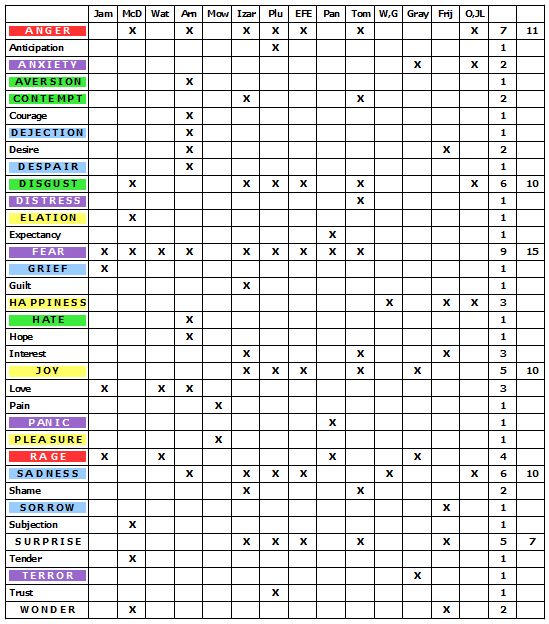
Curious as to why Inside Out depicts those particular emotions, I did some web-surfing to see what great minds have postulated as humankind's basic emotions. I quickly found that there is very little consensus on an exact set of basic emotions. I based most of my more thorough web-researching on the information presented by changingminds.org located on this web page: http://www.changingminds.org/explanations//emotions/basic%20emotions.htm. Below is a thumbnail of a table containing content I reorganized based on said webpage. It shows 14 different conceptions of basic human emotions. (Click the thumbnail to see an enlarged and much more readable image. See footnotes to the table at the bottom of this post.)

Table containing a list of emotions included in theories posited by various researchers

The table shows that the emotions most agreed upon are anger, disgust, fear, joy, and sadness … AND surprise! (See second to last column for exact totals.) However, if you combine synonymous terms (hence the color coding) and total the numbers, surprise falls off a bit. (See the last column.) Maybe that's how Disney•Pixar chose their five emotions for Inside Out. Or maybe they went with Oatley and Johnson-Laird's set because it's the most recent of the 14 theories given on changingminds.org and various other sources. Oatley and Johnson-Laird's list contains the emotions personified in Inside Out but with somewhat different labels: anger, disgust, anxiety (fear?), happiness (joy?), and sadness.

As someone who continues to struggle with my own emotions, I fully understand how researchers over the past hundred years have varied so much in their conclusions. It may seem strange to some, but just a year or so ago I was virtually unable to answer my therapist's question, “How did that make you feel?” I think my emotional vocabulary has expanded, but I still sometimes struggle to label how I feel.

Emotions are important. I hope Inside Out helps adults and children alike recognize their importance and how they influence our interactions with and behavior towards one another. Check out the official trailer from Disney•Pixar's youtube channel below.

NOTE: For full citations, please visit changingminds.org: http://www.changingminds.org/explanations//emotions/basic%20emotions.htm.

Footnotes to the table above:
Jam = William James (1890)? changingminds.org states that James's list of basic emotions comes from his 1884 work, “What Is an Emotion?” I could not verify this. The same list does appear in his 1890 work, The Principles of Psychology, in which he characterizes them as “coarser emotions.”
McD = William McDougall (1926).
Wat = John B. Watson (1930).
Arn = Magda B. Arnold (1960)? I was unable to locate a corresponding source for Arnold's theory of basic emotions.
Mow = Orval Hobart Mowrer (1960).
Izar = Carroll Izard (1977)? changingminds.org states that Izard's list of basic emotions includes distress. Other sources I saw were consistent in his inclusion of sadness rather than distress. Not having read Izard's work directly, I went with the majority in the image above.
Plu = Robert Plutchik (1980).
EFE = Paul Ekman, Wallace V. Friesen, and Phoebe Ellsworth (1982).
Pank = Jaak Panksepp (1982). Panksepp has since expanded his list of basic emotional systems. In the image above I only included the four he gave in his 1982 work.
Tom = Silvan Tomkins (1984).
W,G = Bernard Weiner and Sandra Graham (1984)? I was unable to locate a corresponding source for Weiner and Graham's theory of basic emotions.
Gray = Jeffrey Gray (1985)? I was unable to locate a corresponding source for Gray's theory of basic emotions.
Frij = Nico Frijda (1986).
O,JL = Keith Oatley and Phil Johnson-Laird (1987).

3/30/2015

Bible Verses in Song: “You Are I AM”

If you've read this blog in the past, you may know that sometimes I like finding verses in the Bible that match or contain the same themes as certain contemporary songs. Below are 25 passages that I think correspond to the lyrics of MercyMe's “You Are I AM.” This song does a great job reminding us of God's might and power, particularly in the chorus. The song also reminds us that God is faithful and devoted to his people, though we may sometimes doubt him. If you haven't heard the song, give it a listen. I have shared the official video from YouTube below.

Have no fear of sudden disaster…
for the Lord will be at your side
and will keep your foot from being snared.
(Prov 3:25–26; NIV®)
But God commends his own love toward us, in that while we were yet sinners, Christ died for us…. For if, while we were enemies, we were reconciled to God through the death of his Son, much more, being reconciled, we will be saved by his life. (Rom 5:8, 10)
He safeguards the steps of his faithful ones,
but wicked people are silenced in darkness
because humans cannot succeed by their own strength.
(1 Sam 2:9; GW)
For you are my lamp, Yahweh.
Yahweh will light up my darkness.
….
As for God, his way is perfect.
Yahweh's word is tested.
He is a shield to all those who take refuge in him.
For who is God, besides Yahweh?
Who is a rock, besides our God?
(2 Sam 22:29, 31–32)
Then they cried to Yahweh in their trouble,
and he saved them out of their distresses.
He brought them out of darkness and the shadow of death,
and broke away their chains.
(Psalm 107:13–14)
Where could I go from your Spirit?
Or where could I flee from your presence?
If I ascend up into heaven, you are there.
If I make my bed in Sheol, behold, you are there!
If I take the wings of the dawn,
and settle in the uttermost parts of the sea;
Even there your hand will lead me,
and your right hand will hold me.
(Psalm 139:7–10)
Jesus cried out with a loud voice, and gave up the spirit. The veil of the temple was torn in two from the top to the bottom. (Mark 15:37–38)
But if the Spirit of him who raised up Jesus from the dead dwells in you, he who raised up Christ Jesus from the dead will also give life to your mortal bodies through his Spirit who dwells in you. (Rom 8:11)
Hallelujah!
You servants of the Lord, praise him.
Praise the name of the Lord.
(Psalm 113:1; GW)
Don't you know that your body is a temple that belongs to the Holy Spirit? The Holy Spirit whom you received from God, lives in you. You don't belong to yourselves. (1 Cor 6:19; GW)
Hallelujah!
Praise the name of the Lord.
Praise him, you servants of the Lord
(Psalm 135:1; GW)
You, however, are not in the realm of the flesh but are in the realm of the Spirit, if indeed the Spirit of God lives in you…. (Rom 8:9; NIV®)
Hallelujah!
Praise the Lord, my soul!
(Psalm 146:1; GW)
I will pray to the Father, and he will give you another Counselor, that he may be with you forever,—the Spirit of truth, whom the world can't receive; for it doesn't see him, neither knows him. You know him, for he lives with you, and will be in you. (John 14:16–17)
Hallelujah!
Praise God in his holy place.
Praise him in his mighty heavens.
(Psalm 150:1; GW)
Don't you know that you are God's temple and that God's Spirit lives in you? (1 Cor 3:16; GW)
“The people are strong and tall—descendants of the famous Anakite giants. You've heard the saying ‘Who can stand up to the Anakites?’ But recognize today that the Lord your God is the one who will cross over ahead of you like a devouring fire to destroy them. He will subdue them so that you will quickly conquer them and drive them out, just as the Lord has promised.” (Deut 9:2–3; NLT)
Make sharp the arrows; hold firm the shields: Yahweh has stirred up the spirit of the kings of the Medes; because his purpose is against Babylon, to destroy it: for it is the vengeance of Yahweh, the vengeance of his temple…. Set up a standard in the land, blow the trumpet among the nations, prepare the nations against her, call together against her the kingdoms of Ararat, Minni, and Ashkenaz: appoint a marshal against her; cause the horses to come up as the rough canker worm. Prepare against her the nations, the kings of the Medes, its governors, and all its deputies, and all the land of their dominion. (Jer 51:11, 27–28)
When he came near to the den to Daniel, he cried with a lamentable voice; the king spoke and said to Daniel, Daniel, servant of the living God, is your God, whom you serve continually, able to deliver you from the lions? Then Daniel said to the king, O king, live forever. My God has sent his angel, and has shut the lions' mouths, and they have not hurt me…. (Dan 6:20–22)
Then he said to me, Prophesy to the wind, prophesy, son of man, and tell the wind, Thus says the Lord Yahweh: Come from the four winds, breath, and breathe on these slain, that they may live. So I prophesied as he commanded me, and the breath came into them, and they lived, and stood up on their feet, an exceedingly great army. (Ezek 37:9–10)
Then Nebuchadnezzar the king was astonished, and rose up in haste: he spoke and said to his counselors, Didn't we cast three men bound into the middle of the fire? They answered the king, True, O king. He answered, Look, I see four men loose, walking in the middle of the fire, and they are unharmed; and the aspect of the fourth is like a son of the gods. (Dan 3:24–25)
In my Father's house are many homes. If it weren't so, I would have told you. I am going to prepare a place for you. If I go to prepare a place for you, I will come again, and will receive you to myself; that where I am, you may be there also…. I will not leave you orphans. I will come to you. (John 14:2–3, 18)
The disciples saw Jesus do many other miraculous signs in addition to the ones recorded in this book. But these are written so that you may continue to believe that Jesus is the Messiah, the Son of God, and that by believing in him you will have life by the power of his name. (John 20:30–31; NLT)
God said to Moses, “I AM WHO I AM,” and he said, “You shall tell the children of Israel this: ‘I AM has sent me to you.’” (Ex 3:14)
Jesus said to them, “Most certainly, I tell you, before Abraham came into existence, I AM.” (John 8:58)

Scriptures marked “NIV®”:
Scripture taken from the Holy Bible, NEW INTERNATIONAL VERSION®, NIV® Copyright © 1973, 1978, 1984, 2011 by Biblica, Inc.® Used by permission. All rights reserved worldwide.
NEW INTERNATIONAL VERSION® and NIV® are registered trademarks of Biblica, Inc. Use of either trademark for the offering of goods or services requires prior written consent of Biblica US, Inc.

Scriptures marked “GW”:
Scripture is taken from GOD'S WORD®. Copyright 1995 God's Word to the Nations. Used by permission of Baker Publishing Group. All rights reserved.

Scriptures marked “NLT”:
Scripture quotations marked (NLT) are taken from the Holy Bible, New Living Translation, copyright ©1996, 2004, 2007, 2013 by Tyndale House Foundation. Used by permission of Tyndale House Publishers, Inc., Carol Stream, Illinois 60188. All rights reserved.

In the acknowledgments above, fair use constitutes permission. See https://www.biblica.com/en-us/about-us/terms-of-use/ for Terms of Use and related policies for the NIV®. See http://www.bakerpublishinggroup.com/rights-permissions/permission for permission policies for GOD'S WORD®. See https://www.tyndale.com/00_Home/permissions.php for Permissions information for the NLT.

All other Scriptures:
Scripture quoted from the World English Bible. The World English Bible is in the Public Domain. That means that it is not copyrighted. See copyright information here: https://www.biblegateway.com/versions/World-English-Bible-WEB/#copy.

9/16/2014

The Parable of the Prodigal Son (Part 2)

When last we saw the Prodigal Son, he was watching covetously as the pigs in his charge ate. We're in the middle portion of the parable now, with the Prodigal Son experiencing a moment of self-realization. The parable continues,

But when he came to himself he said, “How many hired servants of my father’s have bread enough to spare, and I’m dying with hunger! I will get up and go to my father, and will tell him, ‘Father, I have sinned against heaven, and in your sight. I am no more worthy to be called your son. Make me as one of your hired servants.’”

He arose, and came to his father. But while he was still far off, his father saw him, and was moved with compassion, and ran, and fell on his neck, and kissed him. The son said to him, “Father, I have sinned against heaven, and in your sight. I am no longer worthy to be called your son.”

But the father said to his servants, “Bring out the best robe, and put it on him. Put a ring on his hand, and shoes on his feet. Bring the fattened calf, kill it, and let us eat, and celebrate; for this, my son, was dead, and is alive again. He was lost, and is found.” They began to celebrate. (Luke 15:17–24)

Have you ever had a moment of self-realization like this? All of a sudden some barrier in your mind is removed or some veil lifted and you truly see your condition or your circumstances. You realize how silly it is for you to continue on in your current state and that you want out. Whether the question in your mind is “Why am I doing this?”, “What am I doing?”, or any other variation on this theme, I think we all can relate. The realization is this: “I have sinned.”

It's hard to admit when we have done something wrong. Depending on how much time we have spent entrenched in sin far away from our heavenly Father, it could be one long and difficult journey. But I think Jesus tells this story to illustrate that we will never take that journey in vain.

Even though we may deliberately set out in sin and distance ourselves from our Father, we can still come home. We can return home starved and gaunt because our Father will recognize us and will prepare a feast to fill our empty bellies. We can return home dirty and clothed in filthy rags because our Father has clean and fine clothing to cover us. We can return home in humility, ashamed of the sins we have committed and with a sincere desire to work for our Father. But though we confess our sin and our unworthiness to him, acknowledging that the way we have lived is not suitable for a child of God and that we are only fit to work for him as hired servants, he will throw his arms around us and rejoice that we have come home. Our relationship with God is not based on the work we do for him. He is always willing to accept us back into his family as his very own children.

Artist James Tissot's painting of 'The Return of the Prodigal Son.'
A rendering of the return of the Prodigal Son [cropped]:
Caption: James Tissot (French, 1836-1902). The Return of the Prodigal Son (Le retour de l'enfant prodigue), 1886–1894. Opaque watercolor over graphite on gray wove paper, Image: 8 11/16 x 5 1/2 in. (22.1 x 14 cm). Brooklyn Museum, Purchased by public subscription, 00.159.185

Scripture quoted from the World English Bible. The World English Bible is in the Public Domain. That means that it is not copyrighted. See copyright information here: https://www.biblegateway.com/versions/World-English-Bible-WEB/#copy.

The image of the Prodigal Son was downloaded from the Brooklyn Museum website. As of 9/16/2014, it is believed that this work is in the Public Domain. You may review the image and related text here: https://www.brooklynmuseum.org/opencollection/objects/4538/The_Return_of_the_Prodigal_Son_Le_retour_de_lenfant_prodigue

8/16/2014

The Parable of the Prodigal Son (Part 1)

Luke 15:11–16 reads,

And [Jesus] said, “A certain man had two sons. And the younger of them said to his father, ‘Father, give me the share of the property that is coming to me.’ So he divided his assets between them. And after not many days, the younger son gathered everything and went on a journey to a distant country, and there he squandered his wealth by living wastefully. And after he had spent everything, there was a severe famine throughout that country, and he began to be in need. And he went and hired himself out to one of the citizens of that country, and he sent him into his fields to tend pigs. And he was longing to fill his stomach with the carob pods that the pigs were eating, and no one was giving anything to him.”

Imagine yourself going about your life, the life God has given you. You decide to leave your Father's house; you have a life plan of your own. You are excited. You have so much life to live, so much energy, so many resources to spend on anything you choose. You take a trip. You visit places you've never been, do things you've never done, and see things you've never seen. Maybe you get a little too excited or too absorbed in what you are doing. Before you know it, you're spent. You have nothing left. You have used up all your energy and all your resources. And, as luck would have it, now there is a widespread famine. Your environment is just as wasted and wanting as you are. So now what? Well, you do the only thing you can do. You join yourself to a citizen of this wasteland. This man sends you to do one of the dirtiest, smelliest jobs around: you become a swineherd.

Living in sin is like being far away from home, destitute in a famine. You have nothing to sustain yourself. And the places and people around you don't provide you with much either, except an offer to tend someone's pigs. And that's what you have to do in order to survive, right? Imagine your daily life, the things you see and smell and hear. Instead of seeing the faces of acquaintances, family, and friends, you see a herd of hungry pigs rummaging about for food. Instead of hearing the voices and laughter of others, you hear a herd of hungry pigs rummaging about for food. Instead of smelling savory food prepared for people, you smell a herd of hungry pigs rummaging about for food. And why can't you stop thinking about food?! Oh look, it's feeding time. Food is brought out for the pigs but none for you. You yearn for what the pigs eat as you watch them devour their food, as you hear their grunting and squealing and snorting and smacking. The food and dirt is caked onto their snouts as the flies swarm around. It makes you hungry. And you long to get down on all fours among the pigs and fill the emptiness inside you.

That is our state when we live in sin. Thank God that is not the end of the story….

The video below contains a slideshow of at least mildly charming pig pictures. However, the point of the video is not to show how cute pigs can be but to demonstrate how disturbing they sound. Listen attentively. Try to imagine yourself in the prodigal son's place: envious of and desiring to eat with pigs.


Scripture quotations from Lexham English Bible. Copyright 2012 Logos Bible Software. Lexham is a registered trademark of Logos Bible Software.

See http://lexhamenglishbible.com/license/ for license information.

7/15/2014

Bible Verses in Song: “My Savior My God”

About 3 years ago I changed the radio station in my car to K-LOVE for the first time. One of the first songs I heard was Aaron Shust's “My Savior My God.” The words were simple yet profound. And the melody seemed to match the feeling behind the words perfectly. That song affects me every time I hear it. You can listen to a performance of the song here: https://www.youtube.com/watch?v=EvBG-FVbGFs.

Aaron Shust's song “My Savior My God” borrows most of its lyrics from an old hymn. This hymn, entitled “My Savior” in the 1885 song book Songs of Joy and Gladness, was composed by Wm. J. Kirkpatrick. However, the words were written by a woman named Dora Greenwell and published (sans music) in 1873 in a slim volume of poetry, Songs of Salvation. Her poem was entitled “Redemption.”

  • You can view Kirkpatrick's song “My Saviour” from Songs of Joy and Gladness by clicking here. You'll notice that Aaron Shust's song contains lyrics from stanzas 1, 2, 4, and 6 and omits stanzas 3 and 5.
  • You can view Greenwell's poem “Redemption” from Songs of Salvation by clicking here. Shust and Kirkpatrick both omit several stanzas from Greenwell's original poem. Only stanzas 1, 2, 4, and 10 appear in both songs.

Isn't it interesting that the thoughts of Greenwell were first set to music almost 150 years ago and then set to music again not even 10 years ago? I must not be the only one who finds great meaning in the words. And you know what? I think that may be because they express truths that are at once universal and deeply personal to everyone who believes in Jesus as their Savior. These truths come from the Bible.

Below are the lyrics from Greenwell's (public domain) poem that are used in Kirkpatrick's and Shust's songs. Accompanying them are corresponding verses from various books of the New Testament. If you come across applicable verses I did not mention, please feel free to share them in a comment. [NOTE: While preparing to write this blog, I stumbled across a post on another blog that is very similar to what I planned to write here. I'll share it in case anyone out there wants to see what other verses were paired up with the lyrics from this song/poem: https://scriptureand.blogspot.com/2012/06/i-am-not-skilled-to-understand.html.]

I am not skilled to understand
What God hath willed; what God hath planned;
I only know at His right hand1
Stands One Who is my Saviour.

1Acts 7:56—And he said, “Behold, I see the heavens opened, and the Son of Man standing at the right hand of God.”


I take God at His word and deed;
“Christ died to save me,”2 this I read,
And in my heart I find a need
Of Him to be my Saviour.

2Rom 5:8–9—[B]ut God shows his love for us in that while we were still sinners, Christ died for us. Since, therefore, we have now been justified by his blood, much more shall we be saved by him from the wrath of God.


That He should leave His place on high,3
And come for sinful man to die,4
You count it strange?—so do not I,
Since I have known my Saviour.

3John 6:38—For I have come down from heaven, not to do my own will but the will of him who sent me.

4Rom 5:6—For while we were still weak, at the right time Christ died for the ungodly.


Yea, living, dying, let me bring
My strength, my solace from this spring,5
That He who lives to be my King,6
Once died to be my Saviour!7

5John 4:13–14—Jesus said to her, “Everyone who drinks of this water will be thirsty again, but whoever drinks of the water that I will give him will never be thirsty again. The water that I will give him will become in him a spring of water welling up to eternal life.”

6Rev 1:5–6—…Jesus Christ, the faithful witness, the firstborn of the dead, and the ruler of kings on earth. To him who loves us and has freed us from our sins by his blood and made us a kingdom, priests to his God and Father, to him be glory and dominion forever and ever. Amen.

71 Thess 5:9–10—For God has not destined us for wrath, but to obtain salvation through our Lord Jesus Christ, who died for us so that whether we are awake or asleep we might live with him.


Scripture quotations are from the ESV* Bible (The Holy Bible, English Standard Version*), copyright © 2001 by Crossway, a publishing ministry of Good News Publishers. Used by permission. All rights reserved.

In the acknowledgment above, fair use constitutes permission. See https://www.crossway.org/support/esv-bible-permissions/ for information on copyright and permissions.

7/01/2013

Learning About Your Attachment Style

Faculty and doctoral candidates at the University of Illinois at Urbana-Champaign are conducting research on attachment, particularly adult attachment. In my amateur research on attachment theory (meaning when I googled it), I came across two websites managed by some of the university's researchers that host or link to attachment-related and personality quizzes/questionnaires: http://www.yourPersonality.net/, maintained by Associate Professor R. Chris Fraley, and http://www.personalityassessor.com, maintained by doctoral candidate Nathan W. Hudson. Researchers are using these online questionnaires for the education of the quiz-taker as well as for collecting information to further their research. (See http://www.yourPersonality.net/about.htm and http://www.personalityassessor.com/about for more specifics.) If you are at all interested in attachment theory or personality assessments, I highly recommend these websites. Both provide informative quiz results that can help you understand more about yourself and how you relate to others in the context of attachment theory. Below are summaries of a few quiz results I received.

From http://www.yourPersonality.net/:

Relationship Structures

This quiz asks questions about four significant relationships in a person's life. Results are plotted on a coordinate grid, placing the quiz-taker in one of four broad attachment categories. All of my results land unquestionably in the “dismissing” area of the graph.

Close Relationships Questionnaire [ECR-R Attachment Style Questionnaire]

This quiz asks questions about your experience in “intimate” relationships, focusing on romantic relationships. The result is plotted on a grid, similar to the results in the Relationship Structures quiz, again placing the quiz-taker in one of the four attachment categories. Not surprisingly, based on my results I have a dismissing attachment style.

From www.personalityassessor.com:

Your Attachment Network

This quiz allows you to choose four significant people in your life and asks you to identify your relationship to them. Several statements are presented and you are prompted to respond in regard to the various relationships you selected. Your results for each relationship are broken down into three general categories: 1) Usage as Attachment Figure, 2) Attachment Anxiety, and 3) Attachment Avoidance. Your attachment style is provided for each relationship as well. To top it all off, your overall levels of Attachment Anxiety and Attachment Avoidance are plotted in comparison to the results of others who have taken the quiz. Once again, my results state that I exhibit a dismissing attachment style. My overall anxiety and avoidance ratings appear below.

I find these websites extremely helpful in learning about and better understanding my attachment pattern/style. This awareness has helped me process a bit more of the distressing aspects in past relationships as well as understanding my struggles in present relationships. Yes, I am insecure in relationships. Yes, I use avoidance tactics to cope with distress. No, it doesn't always have to be this way.

5/27/2013

Attachment Theory: The Basics

Attachment is a concept my therapist has discussed with me at various times in regard to my relationship with my parents. Being the amateur scholar I am, I have read a bit about attachment theory to better understand and see if aspects of it fit my past experience. Below is a conjoined summary of the following sources:

Beginnings of Attachment Theory and Research: Infant Attachment Patterns

Attachment theory was developed by British psychoanalyst John Bowlby in the 1950s. Bowlby developed the theory after observing the separation of infants from their parents. He noted that it is common for infants to try very hard to prevent separation from parents, and, if separated, to try to regain proximity to the absent parents. Bowlby posited that the attachment behavioral system is a product of natural selection that developed because throughout the ages babies who stayed close to their parents, or attachment figures, had a better chance for survival. [Personal note: As a believer in God and His creation of the world and all that is in it, I disagree with Bowlby's assumption that attachment is a product of natural selection; I do, however, agree with the notion that attachment is rooted in human biology. End personal note.]

Attachment serves three basic purposes: 1) It provides a safe haven. 2) It provides a secure base. 3) It regulates physiological arousal.

  1. The safe haven is a real and felt entity, providing both physical and emotional safety. It is a “place” where a child can be safe and feel safe.
  2. The secure base provides a stable shelter from which a child can venture with confidence and explore the larger environment.
  3. The regulation of physiological arousal a child experiences when comforted by a responsive parent promotes his ability to self-regulate and self-soothe on an emotional and physiological level.

Mary Ainsworth's famous “Strange Situation” experiment led to the categorization of relational behaviors into attachment patterns. In the Strange Situation study, 12-month-old infants were observed with mothers, when separated from mothers, and when reunited with mothers. Ainsworth found that there are three distinct attachment patterns in infants: 1) secure; 2) anxious-resistant, an insecure pattern; and 3) avoidant, another insecure pattern.

  1. Secure infants are noticeably upset when separated from their mothers and readily welcome contact and comfort when reunited with their mothers.
  2. Anxious-resistant infants experience high levels of distress when separated from their mothers but seem conflicted when reunited with their mothers; they seem to desire comfort but they also defiantly resist being comforted.
  3. Avoidant infants do not seem very disturbed when separated from their mothers and attempt to avoid their mothers or avert their attention to other things when reunited with their mothers.

Current Attachment Research: Infant and Adult Attachment Patterns

In recent decades, researchers began to study attachment in adults, widening the scope of attachment to relationships other than the parent-child relationship. Research findings authored by Brennan, Clark, and Shaver (1998) iterate that there are two dimensions of adult attachment patterns: anxiety and avoidance. These dimensions recall aspects of Ainsworth's insecure infant attachment patterns.

Researchers have also continued to study infant attachment. Replications and descendants of Ainsworth's Strange Situation repeatedly revealed the need for a fourth category of infant attachment, so the disorganized attachment pattern was added to the three existing categories. The four infant attachment patterns have counterparts in the four adult attachment patterns.

Comparison of Infant Attachment Patterns with Adult Attachment Patterns.

Though there are clearly defined and widely recognized categories of attachment, attachment is, as Allen puts it, “somewhat fluid” (p. 41). Most people have multiple attachment figures throughout the course of their lives. It is possible to have different attachment patterns with different attachment figures. It is also possible for attachment patterns with one attachment figure to change over time. Though these possibilities exist, according to Fraley (2010), the factors that promote change in an individual's attachment patterns are not clearly understood and remain an important area of future research.

1/18/2013

Bible Verses in Song: “Whom Shall I Fear”

A song that resonates with me is Chris Tomlin's “Whom Shall I Fear (God of Angel Armies)” composed by Ed Cash, Scott Cash, and Chris Tomlin. I think one reason it resonates with me so much is that the words paraphrase or capture ideas described in scripture. If you've never heard the song and would like to, or if you have heard it and would like to again, follow this link to Chris Tomlin's VEVO site: https://www.youtube.com/watch?v=qOkImV2cJDg. As an exercise, I tried to pinpoint verses that verify the soundness of the song's lyrics. This is what I came up with.

I have called upon thee, for thou wilt hear me, O God: incline thine ear to me, and hear my speech. (Psalm 17:6)
But I will sing of thy power; yea, I will sing aloud of thy mercy in the morning: for thou hast been my defence and refuge in the day of my trouble. (Psalm 59:16)
If I say, Surely the darkness shall cover me; even the night shall be light about me. Yea, the darkness hideth not from thee; but the night shineth as the day: the darkness and the light are both alike to thee. (Psalm 139:11–12)
God, whose word word I praise,
God I trust; I do not fear.
What can mere flesh do to me?
(Psalm 56:4; LEB)
I have pursued mine enemies, and destroyed them; and turned not again until I had consumed them. And I have consumed them, and wounded them, that they could not arise: yea, they are fallen under my feet. For thou hast girded me with strength to battle: them that rose up against me hast thou subdued under me. (2 Sam 22:38–40)
Happy art thou, O Israel: who is like unto thee, O people saved by the Lord, the shield of thy help, and who is the sword of thy excellency! and thine enemies shall be found liars unto thee; and thou shalt tread upon their high places. (Deut 33:29)
Though I walk in the midst of trouble, thou wilt revive me: thou shalt stretch forth thine hand against the wrath of mine enemies, and thy right hand shall save me. (Psalm 138:7)
God I trust; I do not fear.
What can mere humankind do to me?
(Psalm 56:11; LEB)
The name of the Lord is a strong tower: the righteous runneth into it, and is safe. (Prov 18:10)
I, even I, am the Lord; and beside me there is no saviour. (Isa 43:11)
And call upon me in the day of trouble: I will deliver thee, and thou shalt glorify me. (Psalm 50:15)
O sing unto the Lord a new song; for He hath done marvelous things: his right hand, and his holy arm, hath gotten him the victory. (Psalm 98:1)
The Lord is my light and my salvation;
whom shall I fear?
The Lord is the stronghold of my life;
of whom shall I be afraid?
(Psalm 27:1; ESV)
No weapon that is formed against thee shall prosper; and every tongue that shall rise against thee in judgment thou shalt condemn. This is the heritage of the servants of the Lord, and their righteousness is of me, saith the Lord. (Isa 54:17)
In his hand are the deep places of the earth: the strength of the hills is his also. The sea is his, and he made it: and his hands formed the dry land. (Psalm 95:4–5)
But cleave unto the Lord your God, as ye have done unto this day…. One man of you shall chase a thousand: for the Lord your God, he it is that fighteth for you, as he hath promised you. (Josh 23:8,10)
I will sing of the mercies of the Lord for ever: with my mouth will I make known thy faithfulness to all generations…. (Psalm 89:1)
And the heavens shall praise thy wonders, O Lord: thy faithfulness also in the congregation of the saints…. (Psalm 89:5)
O Lord God of hosts, who is a strong Lord like unto thee? or to thy faithfulness round about thee? (Psalm 89:8)
For ye shall not go out with haste, nor go by flight: for the Lord will go before you; and the God of Israel will be your rearward. (Isa 52:12)
Bless the Lord, ye his angels, that excel in strength, that do his commandments, hearkening unto the voice of his word. Bless ye the Lord, all ye his hosts; ye ministers of his, that do his pleasure. (Psalm 103:20–21)
Be strong and of a good courage, fear not, nor be afraid of them: for the Lord thy God, he it is that doth go with thee; he will not fail thee, nor forsake thee. (Deut 31:6)
The Lord shall reign for ever and ever. (Ex 15:18)
But thou, Israel, art my servant, Jacob whom I have chosen, the seed of Abraham my friend. (Isa 41:8)
The angel of the Lord encampeth round about them that fear him, and delivereth them. (Psalm 34:7)
And the Lord, he it is that doth go before thee; he will be with thee, he will not fail thee, neither forsake thee: fear not, neither be dismayed. (Deut 31:8)

Scripture quotations marked (LEB) are from Lexham English Bible. Copyright 2012 Logos Bible Software. Lexham is a registered trademark of Logos Bible Software.
See http://lexhamenglishbible.com/license/ for license information.

Scripture quotations marked (ESV) are from the ESV* Bible (The Holy Bible, English Standard Version*), copyright © 2001 by Crossway, a publishing ministry of Good News Publishers. Used by permission. All rights reserved.
In the acknowledgment above, fair use constitutes permission. See https://www.crossway.org/support/esv-bible-permissions/ for information on copyright and permissions.

All other scripture quoted from the King James Version of the Bible. The KJV is public domain in the United States. See version information here: https://www.biblegateway.com/versions/King-James-Version-KJV-Bible/#vinfo.

9/24/2012

The First Not-Good Thing

I just finished reading Wladyslaw Szpilman's The Pianist and rereading Jon Krakauer's Into the Wild. Both books include accounts of instances in which the real-life protagonists are profoundly alone.

In The Pianist, Szpilman recounts (among several other horrifying experiences) his survival as a Jew hiding in the ruins of Warsaw also occupied by the German army. For the greater part of 4 months, he had to remain in hiding, completely cut off from interaction with any fellow human being. The only human beings he was able to observe for this duration were part of an army bent on exterminating his people. He remembers the Christmas of 1944 and the New Year celebration of 1945 as being the worst and loneliest holidays of his life. Szpilman was at this time devastated by the undeniable thought that he had to be alone if he wanted to live.

Nearly 50 years after Szpilman suffered 4 agonizing months of necessary solitude in order to survive, Chris McCandless voluntarily and enthusiastically embarked on a solo adventure into the wilderness of Alaska, which lasted almost 4 months, and lost his life. Jon Krakauer pieces together the puzzling story of Chris McCandless's tragic and solitary death in his book Into the Wild. McCandless wanted to travel into the Alaskan wilderness and survive entirely on his own for a time, largely by living off the land. After a few weeks it seems he was more than ready to reenter civilization. However, the small river separating wilderness from civilization that he crossed a few weeks earlier had swelled greatly and treacherously because of glacial melt and seasonal rain. He saw no way to cross. In his improvised journal, two words in that day's entry stand out: “Lonely, scared.” The circumstances leading up to McCandless's death remain a mystery. A note he left at his camp a few days before his death indicates he was desperate for help, injured, weak, and includes the phrase “I am all alone.”

The two men in these accounts experienced an aloneness very few of us can fathom. But I think aloneness is something many of us can relate to if only out of the sense of dread with which it is often associated. To me, feeling alone is one of the most depressing and debilitating experiences a person can endure. Offshoots of this feeling that come to mind are fear, despair, emptiness, desperation, hopelessness.

The account of creation given in the book of Genesis, chapters 1 and 2, is worthy of much study and meditation. I am endlessly in awe of what these words tell us about the world that was created with all that is in it and around it, of how God created and established it, and of how he views and feels about it.

Remember the repetition of a certain phrase throughout chapter 1?: “And God saw that it was good” (Gen 1:10, 12, 18, 21, 25). On either side of this cluster of verses are similar statements: “And God saw that the light was good” (Gen 1:4) and “God saw everything that he had made, and behold, it was very good” (Gen 1:31).

Continue reading in chapter 2 and you will eventually come upon the first not-good thing mentioned in Scripture. Genesis 2:18 reads “Then the Lord God said, ‘It is not good that the man should be alone….’” I believe this statement of God is recorded for several reasons. One reason is to emphasize that man needs help from someone who can relate to him, someone similar to himself. The latter half of God's statement in verse 18 reads, “I will make him a helper fit for him.”

I find it interesting that the word “help” or “helper” is used as the solution to the not-good circumstance of aloneness. The solution was not a particular relation, a child, a brother, or even a wife. A more general term that every person on this earth can relate to was chosen: “help.” God knows we need other people in our lives to help us in the various circumstances we face. He does not want any of us to be alone.

The men in the books mentioned above both found themselves in desperate situations and entirely alone. One man had to be alone to be safe. The other chose a lonely venture. One man received unlikely help from another man and survived, lived to tell his own tale. The other never received help and died alone, his tale only partially pieced together by a man he never knew.

Both men were in situations where they could not simply walk over to a person and ask for help. Most of us have never and will never experience a circumstance even remotely resembling these. However, there are times when we feel alone, and we hurt because of this feeling. In these not-good times, do you see that there is help? Can you find another person to talk to? Can you email a relative, text a sibling, call a friend? The emotional experience of feeling alone is not the same as the reality of being alone. Remember these things, self (and others reading this), when emotion overwhelms actual circumstance. God does not want you to be alone. He did not create you to be alone. He wants you to benefit from the help of other people. He quite literally made it so.

Scripture quotations are from the ESV* Bible (The Holy Bible, English Standard Version*), copyright © 2001 by Crossway, a publishing ministry of Good News Publishers. Used by permission. All rights reserved.

In the acknowledgment above, fair use constitutes permission. See https://www.crossway.org/support/esv-bible-permissions/ for information on copyright and permissions.

3/18/2012

Symptoms of PTSD: Avoidance (Part 3)

All quotes below are from the following Open Access sources and are solely intended for the education of the reader:

  1. Norrholm, S. D., & Jovanovic, T. (2010). Tailoring therapeutic strategies for treating posttraumatic stress disorder symptom clusters. Neuropsychiatric Disease and Treatment, 6, 517–532.
  2. Brousse, G., Arnaud, B., Roger, J. D., Geneste, J., Bourguet, D., Zaplana, F., … Jehel, L. 2011. Management of Traumatic Events: Influence of Emotion-Centered Coping Strategies on the Occurrence of Dissociation and Post-Traumatic Stress Disorder. Neuropsychiatric Disease and Treatment, 7, 127–133.
As described by Friedman [2006], exposure to a traumatic event … can produce a robust emotional response…, and this association can lead to PTSD avoidance symptoms…. (1)
Emotion-centered coping is an attempt to manage the emotional responses induced by the situation…. Numerous strategies belong to this category, including substance abuse, physical activity, expression of emotions, feeling of responsibility, minimization of the event, alteration, denial or avoidance of reality, hoping for a miracle, and use of the imagination. Among all these emotional behaviors, avoidance of the event seems to particularly influence evolution to PTSD, suggesting that emotion-centered strategies (avoidance, flight, denial, or self-accusation) may lead to more negative outcomes after a traumatic event…. (2)
One of the earliest theories proposed to explain avoidance behavior is Mowrer's 2-factor theory [Mowrer, 1960; Levis, 1981], which posits that escape of a fear-conditioned stimulus negatively reinforces avoidance behavior, thereby maintaining fear responses. Applied to PTSD, this theory suggests that avoidance of reminders of the trauma can maintain the disorder by preventing extinction of the original fear associations. (1)

One problem with avoidance is that it keeps you stuck. I think a lot of us construct walls of sorts to keep out the things we'd rather not see, hear, or think about. Certainly avoidance does have its place in preserving our safety and well-being, but when avoidance becomes crippling it is not healthy. And, evidently, scientific inquiry has led us to the conclusion that avoidance of (perceived) fearful things only strengthens the fear association in our brains. I don't know that there is a way to shut off the fear. But I do know that avoidance is only one way to handle it. Several other options exist. I know I have not explored those options enough. I am slowly getting there.

If you struggle with avoidance as well, please be assured that there are other methods of coping. Help is out there. We need to peek over the wall long enough to spot it.