Showing posts with label emotion. Show all posts

1/29/2017

Poem to a Little Child

Little child so filled with fear,
I wish your mom had held you near,
Had hugged you when you felt so scared,
And let you know that someone cared.
Who helped your heart to slow its beat
So you could firmly plant your feet?
No help came, and so you hid
Yourself below a heavy lid.

Little child so filled with rage,
I see you there inside your cage,
Your heart like water boiling hot
Kept beneath the lidded pot.
You swallow down this burning hate;
It’s the portion on your plate.
But oh, dear child, don’t you know
Your rage has nowhere else to go?

Little child, I see your hurt,
Your hard heart crushed to powdery dirt.
I hear your sobbing, hear your cries.
I see your tears and downcast eyes.
I see you when you cannot stand
Without someone to hold your hand—
Locked away inside your vault.
Dear child, this is not your fault.

Little child, God made you good.
I wish you only understood
That you were not created bad.
This sight makes me feel so sad:
To see you out there all alone,
Turning your precious heart to stone
So you don’t feel the aching pain
Of longing that will long remain.

CC0
To the extent possible under law, J has waived all copyright and related or neighboring rights to this work. This work is published from: United States.

9/14/2015

Storms and the Sure Foundation in Isaiah 28

What do you do when the floor drops out from under you? When you are shaken to your very core? When you can't understand what is going on in and around you and nothing makes sense? The only sure thing is confusion. And confusion at its most extreme leads to panic. Have you ever felt like this? Maybe you've experienced the sudden death of a close family member or friend. Maybe you've been diagnosed with a terminal illness. Or maybe the incident that led to this feeling state was somewhat self-inflicted: reckless driving leading to an accident causing severe injury, shared needles leading to HIV, unpaid debt and careless spending leading to bankruptcy or eviction. Perhaps, like me, you experienced something you can't even really explain. You just know your sense of self, the world, and others has been deeply affected.

We live in a world full of sin. I sin and so do all the people around me. I'd guess all the people not around me are in the same boat too. Because this world is full of sin, this world is also full of trials and sorrows. Sometimes we can see the role we play in bringing about trials and sorrows in our own lives. Sometimes we can attribute trials and sorrows in our lives to others we know. And sometimes—sometimes things just happen.

Isaiah 28:2 and 15–18 reads,

Behold, the Lord has a mighty and strong one. Like a storm of hail, a destroying storm, and like a storm of mighty waters overflowing, he will cast them down to the earth with his hand…. “Because you have said, ‘We have made a covenant with death, and with Sheol are we in agreement. When the overflowing scourge passes through, it won’t come to us; for we have made lies our refuge, and we have hidden ourselves under falsehood.’” Therefore thus says the Lord Yahweh, “Behold, I lay in Zion for a foundation a stone, a tried stone, a precious cornerstone of a sure foundation. He who believes shall not act hastily. I will make justice the measuring line, and righteousness the plumb line. The hail will sweep away the refuge of lies, and the waters will overflow the hiding place. Your covenant with death shall be annulled, and your agreement with Sheol shall not stand. When the overflowing scourge passes through, then you will be trampled down by it….” (WEB)

This passage hooked my interest when I read it the other night before going to sleep. There are many things that could be said about these verses. But what sparked my interest was the many parallels I saw in these verses, all of which evoke anxiety.

  • The “storm of hail, a destroying storm” in verse 2 parallels the “hail [that] will sweep away” in verse 17.
  • The “mighty waters overflowing” in verse 2 parallels the “waters [that] will overflow” in verse 17.
  • Verses 15 and 18 both contain the phrase “covenant with death.”
  • Verse 15 quotes Israelites as saying, “with Sheol are we in agreement”; verse 18 also mentions an “agreement with Sheol.”
  • Verses 15 and 18 both discuss an event when an “overflowing scourge passes through.”
  • Verse 15 contains the phrase “lies our refuge” which parallels the “refuge of lies” spoken of in verse 17.
  • The phrase “we have hidden ourselves” in verse 15 parallels the “hiding place” in verse 17.

It sounds like God's people are about to be in the midst of some terrifying situations. Can you imagine their confusion and fear when a (metaphorical?) flood sweeps them away and hail damages all they own? What will they think when the “scourge” whips through? They hid themselves from death and the grave by seeking safety and shelter in lies, looking for security where there was none. How alarming would it be, then, to all of a sudden face life-threatening storms and trials? And even if they survived, what would be left? Would they even recognize where they were? What would they do? How could they go on?

Couched between the corresponding depictions of severe storms, death, and false structures of protection is a beautiful image of hope, stability, and strength. God speaks of a foundation he will lay, starting with a tried and tested stone. Isaiah 28:17 reads, “I lay in Zion for a foundation a stone, a tried stone, a precious cornerstone of a sure foundation. He who believes shall not act hastily.” Those who have a sure foundation can withstand the storms. They will suffer in the storm, like everyone else, but confusion and panic will not overtake them. They will not have to scramble to seek shelter or solid ground to stand on when the hail falls and the floods rise. For those of us who build our lives on and trust in falsehoods, our protective structures will fall when the storms come. And confusion and panic will set in. But if we let him, God can use the storms in our lives to sweep away and overflow all the lies that keep us from safety and stability. It is my prayer that I allow God to sweep away the falsehoods I have taken comfort in and to use the cleared landscape to dig deep and allow him to lay that sure foundation in me.

Scripture quoted from the World English Bible. The World English Bible is in the Public Domain. That means that it is not copyrighted. See copyright information here: https://www.biblegateway.com/versions/World-English-Bible-WEB/#copy.

7/13/2015

What Do I Believe About Sin?

Right now in therapy we are working on processing a traumatic memory from my high school years using EMDR. One of these days I should get around to writing specifically about what EMDR is, but I'll save that for a later time. For now, if you aren't familiar with it (and why would you be? I know I wasn't!) please feel free to toss the letters EMDR into your search engine of choice. There are a lot of fancy and intellectual-sounding words involved, but basically it's like free association while watching lights go back and forth. (My therapist uses a light bar instead of her finger or a baton.)

Last week during EMDR my brain kept going back to some very dark thoughts, like how guilty I feel and that I think I'm going to hell. My therapist does a good job of countering unhealthy or distorted thoughts to help me keep my thoughts moving, but I was very much stuck. She asked me to do an assignment for next week: “What do I believe about sin?” She also asked that I back up my beliefs with scriptures from the New Testament.

As usual, I have been putting off my assignment because I don't like thinking about things outside of my therapist's office. I am still really bad about handling my emotions on my own and tend to avoid them if at all possible. So, naturally, I avoided them to the point of spending a lot of Saturday behaving rather compulsively… which basically means I gave in to sin. After wasting half of my weekend, I resolved to tackle this assignment.

I started out by turning off all distractions and coaching myself to be honest and just think: Without quoting or paraphrasing scripture, what do I truly believe about sin? My therapist didn't ask me to tell her what the Bible says about sin; she asked what I think about sin. So, whether they align with scripture or not, what are my beliefs about sin? This is what I came up with.

  • Sin makes me dirty and disgusting.
  • Sin makes me unlovable and unworthy.
  • Sin covers me where my high school boyfriend touched me, over my clothes and under—like blue paint that won't wash off.
  • Because of my sins I'm going to hell.
  • Everyone can see my sins so I have to hide and stay in the dark. / My sins cut me off from everyone.
  • God doesn't want me because I sin.
  • I shouldn't be forgiven for my sins.
  • My sins are much stronger than I am; they weigh me down, imprison me, and crush me.

As I thought about sin and its influence on me, I started to picture what it would look like if it were some kind of living creature. I had a clear image of this dark greenish brown wormy blob with spikey black hair all over it. It looked like it was decaying as it slither-squirmed across the ground, eerie and disturbing. This is what I keep turning to instead of experiencing my feelings or thoughts that remind me of my past.

Returning to this sinful state and identifying myself so closely with it is not only psychologically unhealthy but also damaging to my spiritual condition and relationship with God. I'm not sure how I have spent nearly three decades, practically my whole life, attending church regularly and studying the Bible and yet clinging to these beliefs that do not align with scripture. There is such a stark contrast between what I know about scripture and what I feel is true about myself and my condition. Perhaps this is why the phrase “renewing your mind” appears in the epistles. Whatever the case, I know that God forgives, and I know He will never leave or forsake me so long as I continue to seek Him. Even if I don't always feel these things are true. I will cling to truth in the scripture instead of my feelings. Lord, be with me and help me to believe what You say is true so that I may serve You with my whole being.

6/22/2015

Reflecting on Inside Out

Yesterday afternoon I went to see Disney•Pixar's newest feature, Inside Out. I've been anticipating this movie's release for the past several weeks, and I was not disappointed. It's an ambitious undertaking to personify human emotions in a movie palatable and entertaining for children and adults alike. But Disney•Pixar didn't stop there. They incorporated several other mental processes into the storyline as well: Abstract thought, Dreaming, and Long-term memory, just to name a few.

Accurately and thoroughly depicting all of these processes and concepts isn't the main purpose of the film. So I'm sure there are neuropsychologists and -scientists out there who can poke holes in some of the finer points of the plot. But, in my opinion, the filmmakers did an incredible job of creating visual representations of these processes in a complex story about a complex subject: the human mind. And WOW, is it visually stunning! Ever wonder what a train of thought looks like? Ever picture different aspects of your personality? Ever imagine how big a storage facility would need to be to contain all of your memories? The human mind is an impressive structure and the Disney•Pixar team illustrates this in clever and interesting ways.

In addition to the intriguing story and impressive visuals, the cast of actors who voiced the emotion characters was well selected. Who embodies Joy better than Amy Poehler, who formerly played perennial optimist Leslie Knope in the TV show Parks and Recreation? Who better to voice Disgust than Mindy Kaling (Kelly Kapoor, the workplace snob) and who better to voice Sadness than Phyllis Smith (Phyllis Lapin/Vance, the workplace sulk) from The Office (U.S. version)? While not as familiar with the male members of the emotion crew, I think they were equally well cast. Fear is played by Bill Hader who I know mainly from voicing the bumbling criminal Mickey in the TV show Bob's Burgers. Anger is voiced by Lewis Black, an actor I am unfamiliar with but who handles Anger quite well.

This movie made me think about how I experience my own emotions and how my emotions sometimes end up controlling my behavior. Like the human characters in the film, I sometimes have emotions behind the control panel, pushing my buttons and causing me to behave in ways that I regret later on. It also made me think about how I am not the only one who has these certain emotions. Everyone around me experiences the same emotions that I do, and their emotions probably influence their behavior in negative ways sometimes as well. That realization alone can help me have greater empathy for those who may act unpleasantly towards me or others.

There were a couple plot points that hit me pretty hard. Like the main (human) character in the film, my family also moved away from my hometown when I was in my preteen years. It was very hard. I didn't even pretend to like it. Once school started I was around complete strangers. I teared up during my speech class once when I gave a brief speech involving my hometown. I was very angry for a long time. And while Anger is perfectly valid and useful, it doesn't always make the best decisions.

Speaking of poor decisions, the worst decision the main (human) character made occurred when her emotions no longer had any influence on her. She became numb and this enabled her to take extreme action. I can relate to this in that I struggle with addiction particularly when I am numb. If I don't feel, then I don't care. And if I don't care, then I do things I wouldn't normally do and that I regret once my emotions are back online.

In my first post about Inside Out I noted the interplay between emotion and behavior. There is a third strand in this story; this strand is called memory. Sound familiar? Probably. These three strands interweave throughout the film and are tied together at the end when we realize the purpose of the most unpopular emotion character: Sadness. As it turns out, Sadness is every bit as important and valuable as the other emotions in the film. And therein lies the lesson. All of our emotions are helpful and worth experiencing, even if they aren't always fun or enjoyable. Emotions color our experiential memories and add greater meaning to our lives.

5/31/2015

Inside Out Coming Soon!

In less than 3 weeks Disney•Pixar's newest feature film will make its debut in theaters across the country. The June issue of The Atlantic contains an article about Inside Out's director, Pete Docter, and the research he conducted while piecing together the storyline. Daniel Smith, the writer of the article, does a good job explaining the director's academic research as well as his personal reflections and experiences that eventually resulted in his newest movie.

I don't often read magazine articles, but I recommend this one to any fans of Disney•Pixar's previous movies or anyone even slightly interested in theories of emotion. There are big-name psychologists mentioned, whom Docter consulted to ensure his storyline was grounded in contemporary emotion theory. (One of the psychologists, Paul Ekman, was cited in my last post which was also about Inside Out.) Click on the link in the citation below to read Daniel Smith's article in The Atlantic. And check out the second official trailer released in the U.S. to see another preview of Inside Out.

Smith, D. (2015, June). Pixar's Mood Master. The Atlantic. Retrieved from https://www.theatlantic.com/magazine/archive/2015/06/pixars-mood-master/392093/.

4/20/2015

Emotions from the Inside Out

In about two months, Disney•Pixar's newest feature film, Inside Out, will be released in theaters. Always a sucker for Disney•Pixar and the old-school animated Disney films, I'm excited to see their new movie. Excited AND interested!

Inside Out, cleverly advertised as an “emotion picture,” is about the interplay of emotions inside the movie's main (human) characters and how this interplay manifests itself in their behavior. Each main (human) character houses a set of five personified emotions: Anger, Disgust, Fear, Joy, and Sadness.

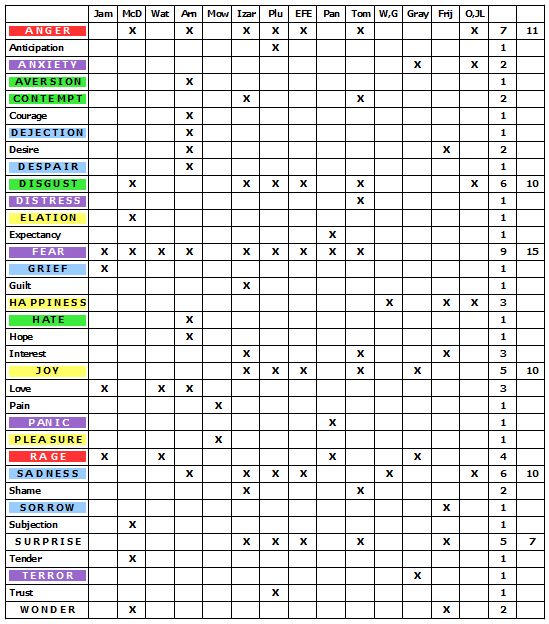
Curious as to why Inside Out depicts those particular emotions, I did some web-surfing to see what great minds have postulated as humankind's basic emotions. I quickly found that there is very little consensus on an exact set of basic emotions. I based most of my more thorough web-researching on the information presented by changingminds.org located on this web page: http://www.changingminds.org/explanations//emotions/basic%20emotions.htm. Below is a thumbnail of a table containing content I reorganized based on said webpage. It shows 14 different conceptions of basic human emotions. (Click the thumbnail to see an enlarged and much more readable image. See footnotes to the table at the bottom of this post.)

Table containing a list of emotions included in theories posited by various researchers

The table shows that the emotions most agreed upon are anger, disgust, fear, joy, and sadness … AND surprise! (See second to last column for exact totals.) However, if you combine synonymous terms (hence the color coding) and total the numbers, surprise falls off a bit. (See the last column.) Maybe that's how Disney•Pixar chose their five emotions for Inside Out. Or maybe they went with Oatley and Johnson-Laird's set because it's the most recent of the 14 theories given on changingminds.org and various other sources. Oatley and Johnson-Laird's list contains the emotions personified in Inside Out but with somewhat different labels: anger, disgust, anxiety (fear?), happiness (joy?), and sadness.

As someone who continues to struggle with my own emotions, I fully understand how researchers over the past hundred years have varied so much in their conclusions. It may seem strange to some, but just a year or so ago I was virtually unable to answer my therapist's question, “How did that make you feel?” I think my emotional vocabulary has expanded, but I still sometimes struggle to label how I feel.

Emotions are important. I hope Inside Out helps adults and children alike recognize their importance and how they influence our interactions with and behavior towards one another. Check out the official trailer from Disney•Pixar's youtube channel below.

NOTE: For full citations, please visit changingminds.org: http://www.changingminds.org/explanations//emotions/basic%20emotions.htm.

Footnotes to the table above:
Jam = William James (1890)? changingminds.org states that James's list of basic emotions comes from his 1884 work, “What Is an Emotion?” I could not verify this. The same list does appear in his 1890 work, The Principles of Psychology, in which he characterizes them as “coarser emotions.”
McD = William McDougall (1926).
Wat = John B. Watson (1930).
Arn = Magda B. Arnold (1960)? I was unable to locate a corresponding source for Arnold's theory of basic emotions.
Mow = Orval Hobart Mowrer (1960).
Izar = Carroll Izard (1977)? changingminds.org states that Izard's list of basic emotions includes distress. Other sources I saw were consistent in his inclusion of sadness rather than distress. Not having read Izard's work directly, I went with the majority in the image above.
Plu = Robert Plutchik (1980).
EFE = Paul Ekman, Wallace V. Friesen, and Phoebe Ellsworth (1982).
Pank = Jaak Panksepp (1982). Panksepp has since expanded his list of basic emotional systems. In the image above I only included the four he gave in his 1982 work.
Tom = Silvan Tomkins (1984).
W,G = Bernard Weiner and Sandra Graham (1984)? I was unable to locate a corresponding source for Weiner and Graham's theory of basic emotions.
Gray = Jeffrey Gray (1985)? I was unable to locate a corresponding source for Gray's theory of basic emotions.
Frij = Nico Frijda (1986).
O,JL = Keith Oatley and Phil Johnson-Laird (1987).

2/10/2015

Transference vs. Projection: What's the Difference?

A couple months ago, I got angry at my therapist. She hadn't done anything to hurt me or offend me or provoke me. I was just mad. So I sent her an email, explaining all the “reasons” why I was angry at her. I clustered those reasons into five paragraphs, all of which started with “I'm angry because….” My therapist sent a kind email in response, thanking me for sending that email to her and assuring me that what I said made sense. When I showed up for my appointment the following week, the first thing she wanted to talk about was that email. She reiterated that the feelings I was having made sense and there was even a word for what I was experiencing. “It's called transference,” she said. Ooooooohhhhhhhh…. That thing. I've heard of that.

Transference. I think a lot of people have heard that term before. For some reason I always confuse that word with another fun psych buzzword: projection. And judging from a brief initial web surfing excursion, I think a lot of people confuse the two. To help me get a firmer grasp on what these terms mean, I read through several seemingly trustworthy web pages about psychology written by psychologists, psychiatrists, and licensed counselors. This is my understanding of transference and projection based on my reading.

Transference takes place when someone transfers another person's qualities, feelings, behaviors, etc., to a different person and then reacts to the different person as if he/she were the other person. (Well said. Or not so much.) Let's try it this way. It takes at least three people to have a transference scenario. So we have three people: I/Me, Present Person, and Past Person. I used to be around Past Person a lot and she always got impatient with Me when I asked questions, so after a while I feared asking her questions because I didn't like being yelled at. Now I hang around Present Person a lot and because I anticipate her becoming impatient just like Past Person, I am afraid to ask Present Person questions for fear she will also yell at me. In a sense, transference is like looking at a person but seeing someone else. The image below depicts a specific instance of transference I experience with my therapist due to previous interactions with my dad.

Illustration of transference: Transferring experiences with my dad to expectations of my therapist.

So even though my therapist is not my dad, and even in my most confused of states I know she's not my dad (the fact that she's female kind of gives that away), I behave as if she is. Because I anticipate her laughing at me if I exhibit emotion around her, I avoid experiencing feelings when I am in her office. This is not the most helpful of things for a person in therapy to do, but at least now I understand that I do it for a reason.

Projection is less complex, in my humble opinion. Projection happens when a person projects their own qualities, feelings, behaviors, etc., onto another person. Whereas transference takes three people, projection only requires two: This time we have I and Other Person. I woke up on the wrong side of the bed and have been a grouchy wretch all day. After an encounter with Other Person, I walk away irritated, complaining to myself about Other Person's grouchiness. The classic example, right? You are acutely aware of the horrible qualities, behaviors, attitudes, etc., of that super-annoying person next to you, only to be informed that it is you who have the horribleness. When you look at that person, you don't see that person, you see you! Horror of all horrors! The image below depicts a possible instance of projection in therapy. [NOTE: I'm not really bitter. I just couldn't think of any of my bad qualities because I'm by myself and I have no one to project them onto right now. Clever, huh?]

Illustration of projection: Projecting my own personality traits onto my therapist.

To manage something effectively, I think you need a basic understanding of what it is you're trying to manage. With my basic understanding of transference and projection, I'm going to try to take note of when I am experiencing these things and learn how to see people for who they are.

1/20/2015

Dad Is Not God

Bearing the image of Him who made you
But your nature has betrayed you,
You're a sinner all the way through—
Dad is not God.

Fallen from grace in your daughter's sight,
Confusing what's wrong with what's right,
Walking in darkness and shunning light—
Dad is not God.

Afraid to look into my father's eyes
For fear of seeing only lies,
He becomes the one I most despise—
Dad is not God.

Bury the pain and hurt. My silenced heart,
Cracked, crumbling, and falling apart,
Needs a mighty hope to restart—
Dad is not God.

The great celestial, skillful Potter
Is my wholly perfect Father,
And I His sinful, broken daughter—
Dad is not God.

CC0
To the extent possible under law, J has waived all copyright and related or neighboring rights to this work. This work is published from: United States.

11/09/2014

The Parable of the Prodigal Son (Part 3)

In the last few verses of The Parable of the Prodigal Son, the older son and the father speak about the younger (and “prodigal”) son who has just returned home.

Now his elder son was in the field. As he came near to the house, he heard music and dancing. He called one of the servants to him, and asked what was going on. He said to him, “Your brother has come, and your father has killed the fattened calf, because he has received him back safe and healthy.” But he was angry, and would not go in. Therefore his father came out, and begged him. But he answered his father, “Behold, these many years I have served you, and I never disobeyed a commandment of yours, but you never gave me a goat, that I might celebrate with my friends. But when this, your son, came, who has devoured your living with prostitutes, you killed the fattened calf for him.”

He said to him, “Son, you are always with me, and all that is mine is yours. But it was appropriate to celebrate and be glad, for this, your brother, was dead, and is alive again. He was lost, and is found.” (Luke 15:25–32)

As a child do you remember taking the position that you were being treated unfairly? That a bratty younger sibling or maybe a bratty classmate was receiving the treatment you felt you deserved? Or maybe as an adult you've experienced something similar, a lazy coworker received accolades while you went unnoticed for all your steady hard work. How did these situations make you feel? A world-famous artist captured this perfectly, I think, in the masterpiece below. [NOTE: By “A world-famous artist,” “captured this perfectly,” and “masterpiece” I actually just mean “I,” “tried to draw this,” and “doodle,” respectively.]

Simple cartoon of the Prodigal Son's older brother.

You felt angry, right? I know I did. It also made me feel small and unappreciated and like I wasn't special. Unfortunately for parents, it's hard to respond to a child who feels slighted and approaches the subject angrily, especially when the child blames the parent; the natural reaction to being blamed for doing something you don't believe is wrong is to become defensive. Maybe you've heard some of these responses before:

  1. “Well, I've got news for you: Life isn't fair.”
  2. “I don't want to hear another word. Go to your room!”
  3. “Why you ungrateful little….”

Do these responses really assuage your anger? Do they help you understand the situation a little better, help you come out of yourself enough to see the situation for what it is and not only how it makes you feel? The first response suggests that, Guess what, kid, you'll be feeling this way all your life. So deal with it. Perhaps life isn't fair, but does that proverb comfort the child and help him understand that he is still wanted and accepted? Does it teach him that others are also wanted and accepted? Probably not. The second response outright dismisses the child's feelings, leaving him to work them out on his own. The takeaway from this would probably be It doesn't matter what I feel because no one listens to me. Also not very helpful. The third response is a case of fighting fire with fire. The child approaches the situation angrily and the parent snaps back angrily. Accusations fly: The parent is being unfair and the child is being ungrateful. This response only makes the child feel worse about the whole situation.

The Father in Jesus's parable handles the interaction with his older son thoughtfully. He listens to his son as he expresses how the situation makes him feel. Instead of being caught up in his own emotional reaction, the Father does not condemn the older son's feelings, but he affirms his relationship with his older son. The Father acknowledges that this son will always be with him and all that he has belongs to him also. To me this is an image of comfort as he quiets the anger of his older child. There is a lesson for the older son to learn in this experience too. It was good for the Father to celebrate and be glad that his younger son had returned home. The Father's reaction was not about which son he liked more; it only had to do with the safe return of his younger son. Without dismissing his older son's feelings, the Father tried to help the older son understand the situation for what it was and not only how it made him feel. What an understanding, patient, and sensitive heavenly Father we have! For in the intensity of our feelings, whether they are just or not, he holds us close to him and will not dismiss us.

Scripture quoted from the World English Bible. The World English Bible is in the Public Domain. That means that it is not copyrighted. See copyright information here: https://www.biblegateway.com/versions/World-English-Bible-WEB/#copy.

4/22/2014

Untitled 2

Help! I am fallen down where
Emotions press me sore.
Loosen these chains. “Oh,
Please!” I cry out softly.

Mend my brokenness, and
End my hopeless thoughts.

Overcome this vile and sinful
Heart, for it hurts itself and others.

Lord, help me be yours,
Only and faithfully yours.
Remove from me fears and
Doubts that pull me from you.

CC0
To the extent possible under law, J has waived all copyright and related or neighboring rights to this work. This work is published from: United States.

3/26/2014

Psalm 56:3

Sometimes I get stuck…. OK, a lot of times I get stuck. Especially when it comes to emotions. I get stuck feeling anxious, sad, scared, or numb. Right now I'm picturing myself in a large(ish) automobile, traveling down a dusty road somewhere in the Outback. Not sure why I'm in Australia, but I am. My tires are whipping up dust clouds and kicking up clods of dry mud and chunks of gravel. It's not a smooth ride, but I'm moving along fine enough. Then, in the amount of time it takes for me to blink, KERTHUNK! My tires have gotten themselves stuck in a giant rut. About 2 minutes later, it's dark outside and I am all alone with my stuck little self in this stuck large(ish) car, and I have no idea how to get out of this predicament.

This current rut is a fear rut. A few weeks ago, I had a casual conversation with a friend that triggered a whole lot of fear. I panicked. I made some poor and frantic decisions. And I ratted myself out to my therapist. She suggested we use the experience as a target for EMDR. (Feel free to Google “EMDR.” It is actually pretty cool.) Even though I have made some pretty substantial progress with EMDR before, I am scared. I am scared because the target is a scary thing for me, and I am scared because I have experienced overwhelming emotions during EMDR in the past.

About 6 months ago, my therapist responded to a rambling email from me. The subject line of that email was “Stuck.” She said,

Just keep moving. The scary won't hurt you, as much as it seems it can. You are OK even when you don't feel that way.

Psalm 56:3 “When I am afraid, I will trust you.”

Keep your mind focused on our God who is faithful, good, and ever present in times of trouble.

Half a year later, I find myself in a similar emotional state. Stuck in scared mode, anticipating tomorrow when we begin another course of EMDR. This time, I am making the words of Psalm 56:3 my own: On my scared days, I will trust God. He is able to help me through.

Scripture quoted in the image above taken from the World English Bible. The World English Bible is in the Public Domain. That means that it is not copyrighted. See copyright information here: https://www.biblegateway.com/versions/World-English-Bible-WEB/#copy.

9/30/2013

Heart of Stone

The word of the Lord came to the priest Ezekiel during the first wave of Babylonian captivity.

… “Thus says the Lord God: I will gather you from the peoples and assemble you out of the countries where you have been scattered, and I will give you the land of Israel.” And when they come there, they will remove from it all its detestable things and all its abominations. And I will give them one heart, and a new spirit I will put within them. I will remove the HEART OF STONE from their flesh and give them a heart of flesh, that they may walk in my statutes and keep my rules and obey them. And they shall be my people, and I will be their God. But as for those whose heart goes after their detestable things and their abominations, I will bring their deeds upon their own heads, declares the Lord God. (Ezek 11:17–21; emphasis mine)
Thus says the Lord God: It is not for your sake, O house of Israel, that I am about to act, but for the sake of my holy name, which you have profaned among the nations to which you came…. I will take you from the nations and gather you from all the countries and bring you into your own land. I will sprinkle clean water on you, and you shall be clean from all your uncleannesses, and from your idols I will cleanse you. And I will give you a new heart, and a new spirit I will put within you. And I will remove the HEART OF STONE from your flesh and give you a heart of flesh. And I will put my Spirit within you, and cause you to walk in my statutes and be careful to obey my rules. You shall dwell in the land that I gave to your fathers, and you shall be my people, and I will be your God. (Ezek 36:22, 24–28; emphasis mine)

A heart of stone. What is that? I think I know. I think I have experienced at least a little bit of what it is like to have a heart made of stone. A heart unresponsive to God's word, to His patience, kindness, mercy, and faithfulness. Knowing and believing that something is wrong but doing it anyway. Instead of praying for strength or escape from temptation, allowing myself to go numb and give in.

Ezekiel prophesied during the reign of Zedekiah. Not much is recorded of Zedekiah in the Chronicles, but enough is said to give us a picture of this man. He was young by our standards. Only 21 when his reign began. Only about 32 when his reign ended in his capture. He rebelled against the King of Babylon though he swore by God he would remain subject to Babylonian authority. Because he swore by God, he rebelled against God in doing this. Despite the prophet Jeremiah's numerous warnings and prophecies, Zedekiah remained unmoved: “He stiffened his neck and hardened his heart against turning to the Lord” (2 Chron 36:11–14).

Ezekiel's prophecies and Zedekiah's example were written for my benefit, for everyone's benefit. Here is a snapshot of my life: I am a young female, 27 years old. I have been struggling with a secret sin on and off for several years but regularly for the past several months. Because of my deliberate and repetitious rebellion against God, I am now captive to this sin, ensnared by it. Not wholly unmoved, but not turning to God, I have grown addicted. I harden my heart when I give in. I harden my heart against God. Once I become numb I am powerless to stop myself.

And yet, God is still God. And He has unfathomable power. John the Baptist proclaimed to the multitudes that came to be baptized, “God is able from these stones to raise up children for Abraham” (Luke 3:8). If God can change stones into living descendants of Abraham, He most certainly can replace a heart of stone with a heart of flesh.

Scripture quotations are from the ESV* Bible (The Holy Bible, English Standard Version*), copyright © 2001 by Crossway, a publishing ministry of Good News Publishers. Used by permission. All rights reserved.

In the acknowledgment above, fair use constitutes permission. See https://www.crossway.org/support/esv-bible-permissions/ for information on copyright and permissions.

8/23/2013

This “Dismissive-Avoidant” in Relation to God

I dismiss my holy Father in heaven. I dismiss His mercy and grace and forgiveness. I dismiss His strength and power and might. I dismiss His wisdom and knowledge and understanding. I dismiss His precious Son who He sent to this earth to live a life of servitude and to ultimately die on the cross for all our sins. I dismiss the Holy Spirit who God sent to dwell within those who believe in Him and His Son.

I avoid my holy Father in heaven. I avoid Him when guilt and shame overwhelm me. I avoid Him when I am tempted and caught in sin. I avoid Him when I am afraid and don't know what to do. I avoid contemplating His Son's sacrifice. I avoid the idea that the Holy Spirit lives within me.

I depend on myself, my own resolve and strength and mind, rather than crying out to God for help. But I am through. I have no more to give in this fight. I am tired of feeling hopeless, afraid, and alone. I need my God and Father in my life.

Once again, Father, I spent several hours of the past few days in sin. You know this but I want to confess my sin to You. You know how I hate it yet am drawn to it. You know how I try to run from it yet I keep returning to it. You know the pangs of guilt I experience near the end of my sin and the wave of shame that washes over me. I am dirty, weak, and lost, Lord God. Please help me to receive and accept Your mercy, grace, and forgiveness; to lean on Your strength, power, and might; to seek counsel in Your wisdom, knowledge, and understanding. Help me to accept that Your Son died for the sins of us all, including my own, and to think often on His sacrifice and what it means for me. Help me to accept and allow the influence of the Holy Spirit in my life. It is by the intercession of the Holy Spirit and through the name of Your Son that I am able to pray to You, Father. Amen.

3/26/2013

Cognitive Restructuring: Letter to My (Baby) Self

Hey, little baby [J],

The first letter I wrote to you was really mean. [My therapist] wanted me to rewrite that letter. At first I didn't think I could do it but then some verses from the Bible popped into my head. Here they are:

“Even if my father and mother abandon me, the Lord will take care of me.” (Psalm 27:10)

A lot of the time it will sort of feel like Mom and Dad aren't really there with you. You will always have enough to eat and drink, and you will always have shoes on your feet and clothes to wear. (Don't worry. You won't always have to wear those frilly dresses.) You will get your teeth brushed, your diapers changed, your hair and body washed. Mom and Dad will make sure of all those things. But once you have 2 or 3 siblings, Mom and Dad won't really hug you or play with you. There are going to be lots of babies in your family and that will be a lot of fun. The babies will get Mom and Dad's hugs and attention. And you might not realize it for a long time, but you will get overlooked and accidentally ignored. And that won't feel good. You won't develop strong, positive attachments to either one of your parents. And a lot of times you will feel empty and alone. But you and I both need to believe that God is able to be there for you and me in ways that Mom and Dad can't be. And that is true for everyone because moms and dads aren't perfect. When you feel alone or forsaken, believe that God still wants to take care of you.

“I was placed in your care from birth. From my mother's womb you have been my God. Do not be so far away from me. Trouble is near, and there is no one to help.” (Psalm 22:10–11)

You are very blessed because your family goes to church and you hear about God. And even though you will wrestle with and question your belief in Him, you will find that God is the only real answer. Around the time you become firm in your belief, there will be a lot of scary and difficult things going on. Your family will have moved to a place where you don't know anybody, and you will not get to go to school with your friends from church. You will go to a very different school and a different church. You will no longer be taught about God by your friends' parents or your relatives or other adults you've known for a long time. You will sit by a boy in school who dies in a car accident. And you will be in a scary and sinful relationship with a boy who was also one of your first friends at your new school. You'll probably notice it then but as the years pass you'll realize it even more: You need help. But you don't know how or who to ask. These situations are too heavy to handle alone. So at night you will pray to God because that is all you can think to do. And you will pray, asking God to hear you even though you have doubted His existence, you continually sin against Him, and you have not committed yourself to following Him. And I do believe He heard you and pulled you out of the relationship you were in. When you didn't know who to go to for help, you went to God. Don't ever stop going to God for help.

“Listen to me, descendants of Jacob, the few people left of the nation of Israel. I've carried you since your birth. I've taken care of you from the time you were born. Even when you're old, I'll take care of you. Even when your hair turns gray, I'll support you. I made you and will continue to care for you. I'll support you and save you.” (Isa 46:3–4)

These verses are from God to His children. No matter how old you get, you will still be God's child. Even after you outgrow your cuteness and you lose your innocence, God will still pick you up and carry you. Even if you live long enough to earn gray hairs, God will still be willing and able to carry you just like your parents did when you were too young to crawl or walk or scoot on your own.

I know you don't feel these things, and neither do I, really, but we both need to believe these things. Maybe in time the feeling will match the faith. It is the faith that matters most, and that is our choice.

J

Scripture is taken from GOD'S WORD®. Copyright 1995 God's Word to the Nations. Used by permission of Baker Publishing Group. All rights reserved.

In the acknowledgment above, fair use constitutes permission. See http://bakerpublishinggroup.com/rights-permissions/permission for information on Licensing and Permissions.

9/24/2012

The First Not-Good Thing

I just finished reading Wladyslaw Szpilman's The Pianist and rereading Jon Krakauer's Into the Wild. Both books include accounts of instances in which the real-life protagonists are profoundly alone.

In The Pianist, Szpilman recounts (among several other horrifying experiences) his survival as a Jew hiding in the ruins of Warsaw also occupied by the German army. For the greater part of 4 months, he had to remain in hiding, completely cut off from interaction with any fellow human being. The only human beings he was able to observe for this duration were part of an army bent on exterminating his people. He remembers the Christmas of 1944 and the New Year celebration of 1945 as being the worst and loneliest holidays of his life. Szpilman was at this time devastated by the undeniable thought that he had to be alone if he wanted to live.

Nearly 50 years after Szpilman suffered 4 agonizing months of necessary solitude in order to survive, Chris McCandless voluntarily and enthusiastically embarked on a solo adventure into the wilderness of Alaska, which lasted almost 4 months, and lost his life. Jon Krakauer pieces together the puzzling story of Chris McCandless's tragic and solitary death in his book Into the Wild. McCandless wanted to travel into the Alaskan wilderness and survive entirely on his own for a time, largely by living off the land. After a few weeks it seems he was more than ready to reenter civilization. However, the small river separating wilderness from civilization that he crossed a few weeks earlier had swelled greatly and treacherously because of glacial melt and seasonal rain. He saw no way to cross. In his improvised journal, two words in that day's entry stand out: “Lonely, scared.” The circumstances leading up to McCandless's death remain a mystery. A note he left at his camp a few days before his death indicates he was desperate for help, injured, weak, and includes the phrase “I am all alone.”

The two men in these accounts experienced an aloneness very few of us can fathom. But I think aloneness is something many of us can relate to if only out of the sense of dread with which it is often associated. To me, feeling alone is one of the most depressing and debilitating experiences a person can endure. Offshoots of this feeling that come to mind are fear, despair, emptiness, desperation, hopelessness.

The account of creation given in the book of Genesis, chapters 1 and 2, is worthy of much study and meditation. I am endlessly in awe of what these words tell us about the world that was created with all that is in it and around it, of how God created and established it, and of how he views and feels about it.

Remember the repetition of a certain phrase throughout chapter 1?: “And God saw that it was good” (Gen 1:10, 12, 18, 21, 25). On either side of this cluster of verses are similar statements: “And God saw that the light was good” (Gen 1:4) and “God saw everything that he had made, and behold, it was very good” (Gen 1:31).

Continue reading in chapter 2 and you will eventually come upon the first not-good thing mentioned in Scripture. Genesis 2:18 reads “Then the Lord God said, ‘It is not good that the man should be alone….’” I believe this statement of God is recorded for several reasons. One reason is to emphasize that man needs help from someone who can relate to him, someone similar to himself. The latter half of God's statement in verse 18 reads, “I will make him a helper fit for him.”

I find it interesting that the word “help” or “helper” is used as the solution to the not-good circumstance of aloneness. The solution was not a particular relation, a child, a brother, or even a wife. A more general term that every person on this earth can relate to was chosen: “help.” God knows we need other people in our lives to help us in the various circumstances we face. He does not want any of us to be alone.

The men in the books mentioned above both found themselves in desperate situations and entirely alone. One man had to be alone to be safe. The other chose a lonely venture. One man received unlikely help from another man and survived, lived to tell his own tale. The other never received help and died alone, his tale only partially pieced together by a man he never knew.

Both men were in situations where they could not simply walk over to a person and ask for help. Most of us have never and will never experience a circumstance even remotely resembling these. However, there are times when we feel alone, and we hurt because of this feeling. In these not-good times, do you see that there is help? Can you find another person to talk to? Can you email a relative, text a sibling, call a friend? The emotional experience of feeling alone is not the same as the reality of being alone. Remember these things, self (and others reading this), when emotion overwhelms actual circumstance. God does not want you to be alone. He did not create you to be alone. He wants you to benefit from the help of other people. He quite literally made it so.

Scripture quotations are from the ESV* Bible (The Holy Bible, English Standard Version*), copyright © 2001 by Crossway, a publishing ministry of Good News Publishers. Used by permission. All rights reserved.

In the acknowledgment above, fair use constitutes permission. See https://www.crossway.org/support/esv-bible-permissions/ for information on copyright and permissions.

7/15/2012

David and Psalm 25

Often when I read the Bible, I forget that the people I am reading about really lived. They had the same physical experiences we have: they perspired when they were hot, shivered when they were cold; to stay alive they had to sleep, eat, and breathe. No duh, right? They also experienced the same emotional and spiritual struggles we wrestle with today. Tonight and several recent days I have found that I relate to the words of David in the 25th psalm.

Remember not the sins of my youth, nor my transgressions… (Psalm 25:7).
Turn thee unto me, and have mercy upon me; for I am desolate and afflicted. The troubles of my heart are enlarged: O bring thou me out of my distresses. Look upon my affliction and my pain; and forgive all my sins (Psalm 25:16–18).

David went through so many trials in his life and time and time again he cried out to God. In this way I want to strive to be more like David.

Scripture quoted from the King James Version of the Bible. The KJV is public domain in the United States. See version information here: https://www.biblegateway.com/versions/King-James-Version-KJV-Bible/#vinfo.

3/18/2012

Symptoms of PTSD: Avoidance (Part 3)

All quotes below are from the following Open Access sources and are solely intended for the education of the reader:

  1. Norrholm, S. D., & Jovanovic, T. (2010). Tailoring therapeutic strategies for treating posttraumatic stress disorder symptom clusters. Neuropsychiatric Disease and Treatment, 6, 517–532.
  2. Brousse, G., Arnaud, B., Roger, J. D., Geneste, J., Bourguet, D., Zaplana, F., … Jehel, L. 2011. Management of Traumatic Events: Influence of Emotion-Centered Coping Strategies on the Occurrence of Dissociation and Post-Traumatic Stress Disorder. Neuropsychiatric Disease and Treatment, 7, 127–133.
As described by Friedman [2006], exposure to a traumatic event … can produce a robust emotional response…, and this association can lead to PTSD avoidance symptoms…. (1)
Emotion-centered coping is an attempt to manage the emotional responses induced by the situation…. Numerous strategies belong to this category, including substance abuse, physical activity, expression of emotions, feeling of responsibility, minimization of the event, alteration, denial or avoidance of reality, hoping for a miracle, and use of the imagination. Among all these emotional behaviors, avoidance of the event seems to particularly influence evolution to PTSD, suggesting that emotion-centered strategies (avoidance, flight, denial, or self-accusation) may lead to more negative outcomes after a traumatic event…. (2)
One of the earliest theories proposed to explain avoidance behavior is Mowrer's 2-factor theory [Mowrer, 1960; Levis, 1981], which posits that escape of a fear-conditioned stimulus negatively reinforces avoidance behavior, thereby maintaining fear responses. Applied to PTSD, this theory suggests that avoidance of reminders of the trauma can maintain the disorder by preventing extinction of the original fear associations. (1)

One problem with avoidance is that it keeps you stuck. I think a lot of us construct walls of sorts to keep out the things we'd rather not see, hear, or think about. Certainly avoidance does have its place in preserving our safety and well-being, but when avoidance becomes crippling it is not healthy. And, evidently, scientific inquiry has led us to the conclusion that avoidance of (perceived) fearful things only strengthens the fear association in our brains. I don't know that there is a way to shut off the fear. But I do know that avoidance is only one way to handle it. Several other options exist. I know I have not explored those options enough. I am slowly getting there.

If you struggle with avoidance as well, please be assured that there are other methods of coping. Help is out there. We need to peek over the wall long enough to spot it.

11/19/2011

Fear and PTSD

Fear forcing past into present
Or present into past?
Heart, lungs, beating and breathing fast
Post-shame, post-guilt, post-pain:
What comes after? More of the same.

Fear changing stone into soldier,
Or soldier into stone?
Body, mind, haggard and hollow bone
Traumatized, tantalized
By what's before, behind the eyes.

Fear pushing child into adult
Or adult into child?
Limbs, legs, trembling and tangling wild
Stress out, stress in, stressed still
And always now; against the will.

Fear forcing life into chaos
Or chaos into life?
Head, heart, disarmed and disrobed strife,
Disordered, and diseased,
Burning with fear in a frozen freeze.

CC0
To the extent possible under law, J has waived all copyright and related or neighboring rights to this work. This work is published from: United States.

10/26/2011

A Blasphemous Brain

Intellect says,

  • I believe that God created the heavens and the earth in six days and on the seventh day He rested (Gen 1:1–2:23);
  • I believe that God valued man highly from the very beginning because He created man in His image and gave him dominion over all His other living creations (Gen 1:26–31, 2:19);
  • I believe that God breathed the breath of life into the first human (Gen 2:7) and continues to supply each one of us with the breath of life today (Acts 17:24–28);
  • I believe that every person to ever walk this earth (with the exception of one man who will shortly be named) has sinned against and rejected his/her Creator and Life Preserver (Rom 3:23);
  • I believe that because each one of us has sinned, God sent His Son, Jesus Christ, to this earth to save us from our sins (John 3:17);
  • I believe that Christ always did (and still does) His Father's will (Luke 2:49; Mark 19:46);
  • I believe that Christ fulfilled His Father's will by bearing our temptations, sorrows, beatings, humiliations, and sins, and by facing total separation from His God and Father on the cross (Heb 2:17–18, Matt 26:36–38, Matt 26:66–67, Matt 27:27–31, 2 Cor 5:21, and Matt 27:46, respectively);
  • God's motive for all that He did, does, and will do is “love” (1 John 4:8–10).

Intellect believes all of those things are true (and provides ample evidence for these assertions), and yet Emotion feels that the following is true (enter blasphemy):

“Love” is impatient and unkind; “love” envies and boasts; “love” is arrogant and rude. It insists on getting its own way; it is irritable and resentful; it rejoices at wrongdoing, but does not rejoice in the truth; it does not bear all things, does not believe all things, does not hope all things, does not endure all things. “Love” will end. (Grossly distorted 1 Cor 13:4–8)

Intellect knows that distortion is a lie. For truth, see the real 1 Cor 13:4–8. This distortion of “love” is a wall between me and others, and more importantly and devastatingly, between me and God. In 1 John 4:8, John writes, “God is love.” Emotion immediately kicks in and scratches out the word “love” and replaces it with “a lie.” Intellect knows that THAT is a lie. But the lie feels stronger than the truth. There is a constant brain battle between Intellect and Emotion. When I can quiet my brain enough to listen, these are the words I need to hear:

Prov 3:5—Trust in the Lord with all your heart, and do not lean on your own understanding.

Scripture quotations are from (and grossly distorted from) the ESV* Bible. In other words…

Scripture quotations are from the ESV* Bible (The Holy Bible, English Standard Version*), copyright © 2001 by Crossway, a publishing ministry of Good News Publishers. Used by permission. All rights reserved.

In the acknowledgment above, fair use constitutes permission. See https://www.crossway.org/support/esv-bible-permissions/ for information on copyright and permissions.