8/24/2015

When Friends Don't Understand

Last night I confided in a good friend something that happened to me several years ago. This is an event I have been working on in therapy for the past few weeks. It's incredibly personal and makes me feel more than a little vulnerable to disclose. But I've been friends with this person for a couple of years and she has proven to be a very understanding and sensitive friend. To my surprise, she didn't understand my experience or its effect on me. Nor did she understand my explanation as to why this experience has had such an impact on me. Her response was very kindly put, but in essence what she was saying to me was, “So…?” OUCH!!! That really hurt. I didn't realize until it was too late that what I was craving was her understanding. Someone to intellectually and emotionally connect with my past experience and my past and current hurt. But she didn't. The conversation I had with this good friend didn't help me at all. It only confused me and hurt me more, despite her careful choice of words and best intentions.

Perhaps I was asking too much. Perhaps this was not the right friend to confide in. Or perhaps this was just an example of the limitations of human sympathy and understanding. I am starting to realize that situations like these, where a friend unintentionally disappoints me and hurts me, are necessary for me to experience. If there were a person on this earth who could always help me, always sympathize with me, always understand me, why would I need God? I believe God works through people to fulfill his purposes and to help us, but I also think I struggle to rely “just” on God, thinking of him as a secondary source of support. Correct me even in my hurt, God, that I may learn to rely on and trust in you as my primary source of support and understanding. May the words of David be true for us also that we realize you are the one who fully knows us and is always near to help us:

Yahweh, you have searched me,
and you know me.
You know my sitting down and my rising up.
You perceive my thoughts from afar.
You search out my path and my lying down,
and are acquainted with all my ways.
For there is not a word on my tongue,
but, behold, Yahweh, you know it altogether.
You hem me in behind and before.
You laid your hand on me.
This knowledge is beyond me.
It’s lofty.
I can’t attain it.
Where could I go from your Spirit?
Or where could I flee from your presence?
If I ascend up into heaven, you are there.
If I make my bed in Sheol, behold, you are there!
If I take the wings of the dawn,
and settle in the uttermost parts of the sea;
Even there your hand will lead me,
and your right hand will hold me.
(Psalm 139:1–10)

Scripture quoted from the World English Bible. The World English Bible is in the Public Domain. That means that it is not copyrighted. See copyright information here: https://www.biblegateway.com/versions/World-English-Bible-WEB/#copy.

7/13/2015

What Do I Believe About Sin?

Right now in therapy we are working on processing a traumatic memory from my high school years using EMDR. One of these days I should get around to writing specifically about what EMDR is, but I'll save that for a later time. For now, if you aren't familiar with it (and why would you be? I know I wasn't!) please feel free to toss the letters EMDR into your search engine of choice. There are a lot of fancy and intellectual-sounding words involved, but basically it's like free association while watching lights go back and forth. (My therapist uses a light bar instead of her finger or a baton.)

Last week during EMDR my brain kept going back to some very dark thoughts, like how guilty I feel and that I think I'm going to hell. My therapist does a good job of countering unhealthy or distorted thoughts to help me keep my thoughts moving, but I was very much stuck. She asked me to do an assignment for next week: “What do I believe about sin?” She also asked that I back up my beliefs with scriptures from the New Testament.

As usual, I have been putting off my assignment because I don't like thinking about things outside of my therapist's office. I am still really bad about handling my emotions on my own and tend to avoid them if at all possible. So, naturally, I avoided them to the point of spending a lot of Saturday behaving rather compulsively… which basically means I gave in to sin. After wasting half of my weekend, I resolved to tackle this assignment.

I started out by turning off all distractions and coaching myself to be honest and just think: Without quoting or paraphrasing scripture, what do I truly believe about sin? My therapist didn't ask me to tell her what the Bible says about sin; she asked what I think about sin. So, whether they align with scripture or not, what are my beliefs about sin? This is what I came up with.

  • Sin makes me dirty and disgusting.
  • Sin makes me unlovable and unworthy.
  • Sin covers me where my high school boyfriend touched me, over my clothes and under—like blue paint that won't wash off.
  • Because of my sins I'm going to hell.
  • Everyone can see my sins so I have to hide and stay in the dark. / My sins cut me off from everyone.
  • God doesn't want me because I sin.
  • I shouldn't be forgiven for my sins.
  • My sins are much stronger than I am; they weigh me down, imprison me, and crush me.

As I thought about sin and its influence on me, I started to picture what it would look like if it were some kind of living creature. I had a clear image of this dark greenish brown wormy blob with spikey black hair all over it. It looked like it was decaying as it slither-squirmed across the ground, eerie and disturbing. This is what I keep turning to instead of experiencing my feelings or thoughts that remind me of my past.

Returning to this sinful state and identifying myself so closely with it is not only psychologically unhealthy but also damaging to my spiritual condition and relationship with God. I'm not sure how I have spent nearly three decades, practically my whole life, attending church regularly and studying the Bible and yet clinging to these beliefs that do not align with scripture. There is such a stark contrast between what I know about scripture and what I feel is true about myself and my condition. Perhaps this is why the phrase “renewing your mind” appears in the epistles. Whatever the case, I know that God forgives, and I know He will never leave or forsake me so long as I continue to seek Him. Even if I don't always feel these things are true. I will cling to truth in the scripture instead of my feelings. Lord, be with me and help me to believe what You say is true so that I may serve You with my whole being.

6/22/2015

Reflecting on Inside Out

Yesterday afternoon I went to see Disney•Pixar's newest feature, Inside Out. I've been anticipating this movie's release for the past several weeks, and I was not disappointed. It's an ambitious undertaking to personify human emotions in a movie palatable and entertaining for children and adults alike. But Disney•Pixar didn't stop there. They incorporated several other mental processes into the storyline as well: Abstract thought, Dreaming, and Long-term memory, just to name a few.

Accurately and thoroughly depicting all of these processes and concepts isn't the main purpose of the film. So I'm sure there are neuropsychologists and -scientists out there who can poke holes in some of the finer points of the plot. But, in my opinion, the filmmakers did an incredible job of creating visual representations of these processes in a complex story about a complex subject: the human mind. And WOW, is it visually stunning! Ever wonder what a train of thought looks like? Ever picture different aspects of your personality? Ever imagine how big a storage facility would need to be to contain all of your memories? The human mind is an impressive structure and the Disney•Pixar team illustrates this in clever and interesting ways.

In addition to the intriguing story and impressive visuals, the cast of actors who voiced the emotion characters was well selected. Who embodies Joy better than Amy Poehler, who formerly played perennial optimist Leslie Knope in the TV show Parks and Recreation? Who better to voice Disgust than Mindy Kaling (Kelly Kapoor, the workplace snob) and who better to voice Sadness than Phyllis Smith (Phyllis Lapin/Vance, the workplace sulk) from The Office (U.S. version)? While not as familiar with the male members of the emotion crew, I think they were equally well cast. Fear is played by Bill Hader who I know mainly from voicing the bumbling criminal Mickey in the TV show Bob's Burgers. Anger is voiced by Lewis Black, an actor I am unfamiliar with but who handles Anger quite well.

This movie made me think about how I experience my own emotions and how my emotions sometimes end up controlling my behavior. Like the human characters in the film, I sometimes have emotions behind the control panel, pushing my buttons and causing me to behave in ways that I regret later on. It also made me think about how I am not the only one who has these certain emotions. Everyone around me experiences the same emotions that I do, and their emotions probably influence their behavior in negative ways sometimes as well. That realization alone can help me have greater empathy for those who may act unpleasantly towards me or others.

There were a couple plot points that hit me pretty hard. Like the main (human) character in the film, my family also moved away from my hometown when I was in my preteen years. It was very hard. I didn't even pretend to like it. Once school started I was around complete strangers. I teared up during my speech class once when I gave a brief speech involving my hometown. I was very angry for a long time. And while Anger is perfectly valid and useful, it doesn't always make the best decisions.

Speaking of poor decisions, the worst decision the main (human) character made occurred when her emotions no longer had any influence on her. She became numb and this enabled her to take extreme action. I can relate to this in that I struggle with addiction particularly when I am numb. If I don't feel, then I don't care. And if I don't care, then I do things I wouldn't normally do and that I regret once my emotions are back online.

In my first post about Inside Out I noted the interplay between emotion and behavior. There is a third strand in this story; this strand is called memory. Sound familiar? Probably. These three strands interweave throughout the film and are tied together at the end when we realize the purpose of the most unpopular emotion character: Sadness. As it turns out, Sadness is every bit as important and valuable as the other emotions in the film. And therein lies the lesson. All of our emotions are helpful and worth experiencing, even if they aren't always fun or enjoyable. Emotions color our experiential memories and add greater meaning to our lives.

5/31/2015

Inside Out Coming Soon!

In less than 3 weeks Disney•Pixar's newest feature film will make its debut in theaters across the country. The June issue of The Atlantic contains an article about Inside Out's director, Pete Docter, and the research he conducted while piecing together the storyline. Daniel Smith, the writer of the article, does a good job explaining the director's academic research as well as his personal reflections and experiences that eventually resulted in his newest movie.

I don't often read magazine articles, but I recommend this one to any fans of Disney•Pixar's previous movies or anyone even slightly interested in theories of emotion. There are big-name psychologists mentioned, whom Docter consulted to ensure his storyline was grounded in contemporary emotion theory. (One of the psychologists, Paul Ekman, was cited in my last post which was also about Inside Out.) Click on the link in the citation below to read Daniel Smith's article in The Atlantic. And check out the second official trailer released in the U.S. to see another preview of Inside Out.

Smith, D. (2015, June). Pixar's Mood Master. The Atlantic. Retrieved from https://www.theatlantic.com/magazine/archive/2015/06/pixars-mood-master/392093/.

4/20/2015

Emotions from the Inside Out

In about two months, Disney•Pixar's newest feature film, Inside Out, will be released in theaters. Always a sucker for Disney•Pixar and the old-school animated Disney films, I'm excited to see their new movie. Excited AND interested!

Inside Out, cleverly advertised as an “emotion picture,” is about the interplay of emotions inside the movie's main (human) characters and how this interplay manifests itself in their behavior. Each main (human) character houses a set of five personified emotions: Anger, Disgust, Fear, Joy, and Sadness.

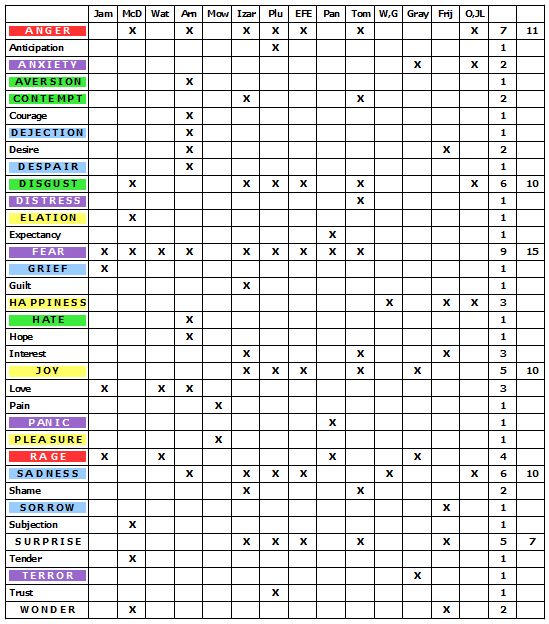
Curious as to why Inside Out depicts those particular emotions, I did some web-surfing to see what great minds have postulated as humankind's basic emotions. I quickly found that there is very little consensus on an exact set of basic emotions. I based most of my more thorough web-researching on the information presented by changingminds.org located on this web page: http://www.changingminds.org/explanations//emotions/basic%20emotions.htm. Below is a thumbnail of a table containing content I reorganized based on said webpage. It shows 14 different conceptions of basic human emotions. (Click the thumbnail to see an enlarged and much more readable image. See footnotes to the table at the bottom of this post.)

Table containing a list of emotions included in theories posited by various researchers

The table shows that the emotions most agreed upon are anger, disgust, fear, joy, and sadness … AND surprise! (See second to last column for exact totals.) However, if you combine synonymous terms (hence the color coding) and total the numbers, surprise falls off a bit. (See the last column.) Maybe that's how Disney•Pixar chose their five emotions for Inside Out. Or maybe they went with Oatley and Johnson-Laird's set because it's the most recent of the 14 theories given on changingminds.org and various other sources. Oatley and Johnson-Laird's list contains the emotions personified in Inside Out but with somewhat different labels: anger, disgust, anxiety (fear?), happiness (joy?), and sadness.

As someone who continues to struggle with my own emotions, I fully understand how researchers over the past hundred years have varied so much in their conclusions. It may seem strange to some, but just a year or so ago I was virtually unable to answer my therapist's question, “How did that make you feel?” I think my emotional vocabulary has expanded, but I still sometimes struggle to label how I feel.

Emotions are important. I hope Inside Out helps adults and children alike recognize their importance and how they influence our interactions with and behavior towards one another. Check out the official trailer from Disney•Pixar's youtube channel below.

NOTE: For full citations, please visit changingminds.org: http://www.changingminds.org/explanations//emotions/basic%20emotions.htm.

Footnotes to the table above:
Jam = William James (1890)? changingminds.org states that James's list of basic emotions comes from his 1884 work, “What Is an Emotion?” I could not verify this. The same list does appear in his 1890 work, The Principles of Psychology, in which he characterizes them as “coarser emotions.”
McD = William McDougall (1926).
Wat = John B. Watson (1930).
Arn = Magda B. Arnold (1960)? I was unable to locate a corresponding source for Arnold's theory of basic emotions.
Mow = Orval Hobart Mowrer (1960).
Izar = Carroll Izard (1977)? changingminds.org states that Izard's list of basic emotions includes distress. Other sources I saw were consistent in his inclusion of sadness rather than distress. Not having read Izard's work directly, I went with the majority in the image above.
Plu = Robert Plutchik (1980).
EFE = Paul Ekman, Wallace V. Friesen, and Phoebe Ellsworth (1982).
Pank = Jaak Panksepp (1982). Panksepp has since expanded his list of basic emotional systems. In the image above I only included the four he gave in his 1982 work.
Tom = Silvan Tomkins (1984).
W,G = Bernard Weiner and Sandra Graham (1984)? I was unable to locate a corresponding source for Weiner and Graham's theory of basic emotions.
Gray = Jeffrey Gray (1985)? I was unable to locate a corresponding source for Gray's theory of basic emotions.
Frij = Nico Frijda (1986).
O,JL = Keith Oatley and Phil Johnson-Laird (1987).